Three medical students develop a digital guide to medicines


The RSU Business Incubator provides an opportunity to test business ideas, develop them alongside mentors and project supervisors, and work step by step towards a practical solution. Continuing our series on the three best projects from the incubator’s Demo Day, this time we would like to introduce Medrix.
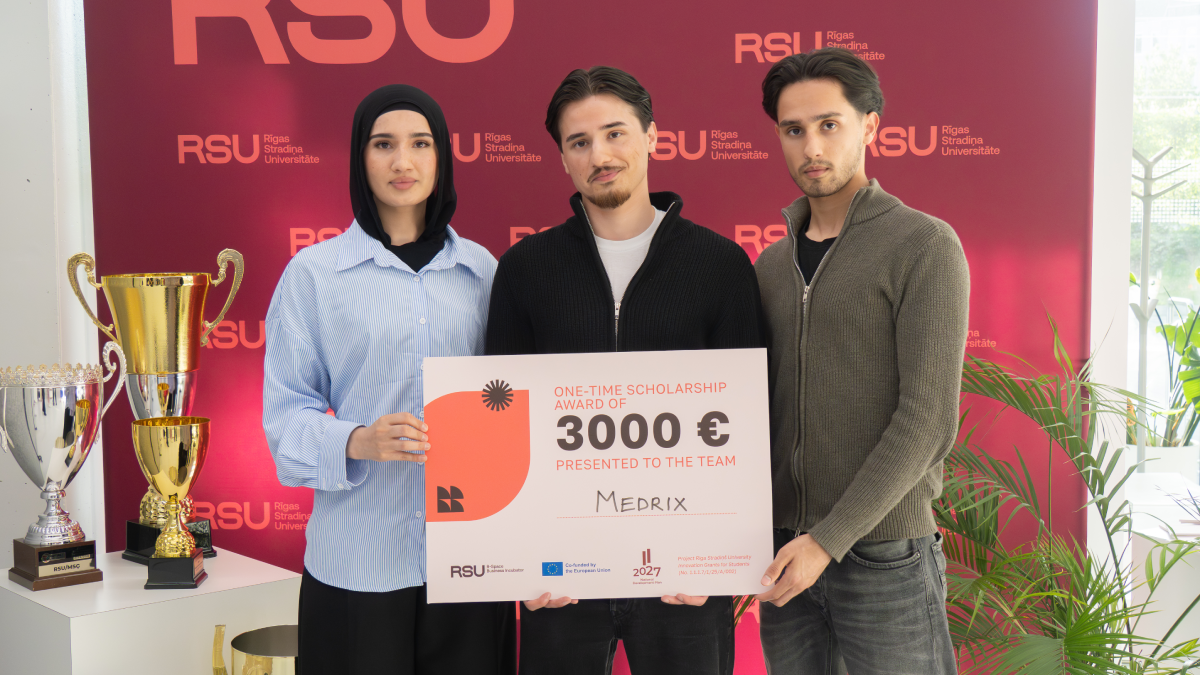
The team is composed of three medical students and, at the same time, members of one family. Ahmed Rahimi and Mansur Rahimi study at Rīga Stradiņš University (RSU), while Mariam Rahimi pursues her medical studies at Linköping University in Sweden. Their aim is to help people quickly access accurate, up-to-date and official information on specific medicines. In this interview, students talk about their innovation and the support provided by RSU Business Incubator in its development.
What is Medrix and how did this idea come about?
The idea was inspired by a challenge from the RSU Business Incubator’s idea bank, where companies are invited to submit real-life problems and challenges that require new solutions.
At the beginning of the year, we chose to address a problem related to access to information about medicines.
Although official information on medicines is publicly available, in everyday life it is often found in a folded leaflet or a lengthy PDF document, which is not particularly convenient for quick and practical use.
We therefore set out to investigate whether the barcode already on medicine packaging could be used as a simple way of accessing the official information for that particular medicine directly on a mobile phone.
How do you divide responsibilities within your team?
Ahmed oversees product and technical development, as well as collaboration with external partners. To test the idea in practice, he independently learned to code. Mansur focuses on research and preparing the necessary information before important meetings, while Mariam provides her clinical perspective to the team, based on her patient-care experience and her knowledge of the Swedish healthcare system.
Who are your potential clients?
The primary commercial focus is the State Agency of Medicines. It is the organisation responsible for ensuring that approved information on medicines is accurate and up to date.
It should be simple for patients to use. They simply scan the packaging to receive the latest information.
Our aim is to keep this access free of charge. Organisations, on the other hand, would pay for the process of verifying, updating and controlling the publication of the information.
How do you keep information on thousands of medicines up to date?
We do not write the instructions for use of medicines ourselves, nor do we use artificial intelligence to generate or rewrite medical facts and hypotheses. The source is information approved by the State Agency of Medicines, the marketing authorisation holder or the European Medicines Agency.
First, we identify the specific pack using a barcode or Data Matrix code, then link it to the relevant medicine and instructions.
Official information is displayed on the phone in a structured and clear format.
The system also tracks the source version and any changes. If any uncertainties arise, the process is paused and the information is forwarded for verification.
How did incubation programme change Medrix?
The recommendations from the invited mentors focused on the division of responsibilities within our team, defining our target customers and the costs of the service. The business incubation programme helped us to distinguish between users and buyers. A patient may be a user, but the first paying client will most likely be the organisation responsible for approving medicinal product information.
Aigars Asmis helped us to navigate the incubation programme and establish contacts with industry experts. Meanwhile, Vadims Ķīsis, the industry-appointed project supervisor, encouraged us to define our solution more precisely: what problem it solves and where its main value lies. Initially, Medrix was intended as a broad, multifunctional solution for patients; however, during the programme, the focus became much clearer.
Thanks to the incubator and the project supervisor, Medrix was defined and developed as a digital guide to medicines for Latvia, based on official sources of information, accurate identification of medicine packaging and controlled updating of information.
What was the most significant achievement?
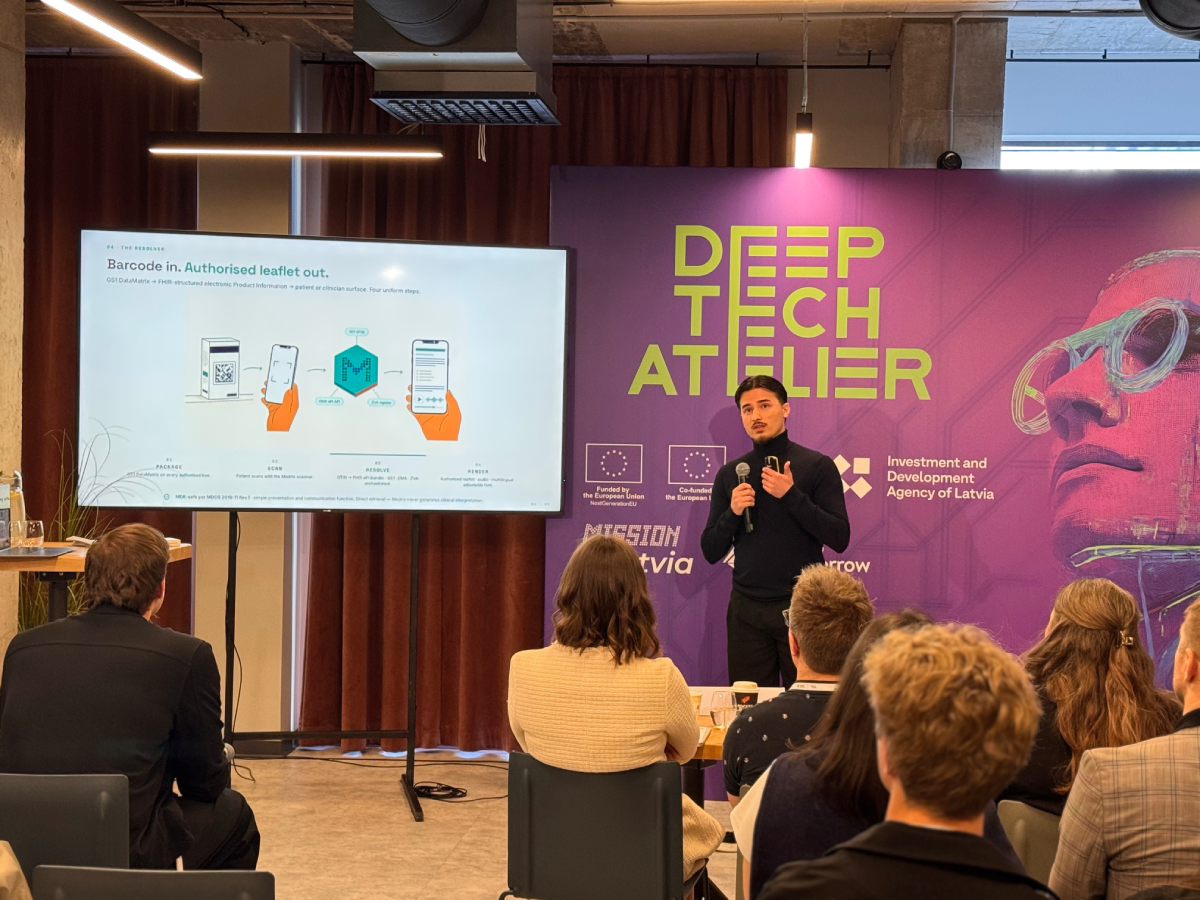
It was the first successful scan of a real medicine package. The phone recognised the barcode and opened the correct official patient information leaflet in clearly organised sections in less than two seconds. We later demonstrated the solution using real medicine packages at Deep Tech Atelier and RSU Demo Day.
What do Medrix’s achievements mean to you?
If anyone in Latvia was able to easily access relevant, current and officially verified information by scanning a medicine package, we would consider that a success.
Currently, our nearest objective is to establish a fully verified and paid cooperation model with a marketing authorisation holder. Once this model is successfully tested in Latvia, we will be able to think about further development and expansion of the solution.
What would your advice be to students who wish to develop their healthcare idea?
If you intend to develop healthcare solutions, initially, it is worth focusing on a single, clearly defined issue and creating a comprehensive and safe solution for it. In healthcare, the user, buyer and legally responsible organisation are often different parties; therefore, it is important to understand the needs and responsibilities of each party at an early stage.
It is just as important to talk to the parties involved at an early stage, to prepare thoroughly for negotiations, and to be prepared to revise the original plan if the information obtained shows that one of the assumptions was incorrect.
This is exactly where participation in the RSU Business Incubator was particularly important. The incubation programme helped the team to formulate the idea, verify assumptions and understand more clearly what the solution is intended for and the value it creates. Working with mentors and industry experts gave us the opportunity to take a more critical look at the idea and gradually turn it into a testable solution.