
Distance in Human Networks. Part two


With this blog post, we continue the three-part series by network analysis expert and (R)E-TIES researcher Valdis Krebs on distance in human networks. In this installment, the researcher discusses the benefits of some distance in human networks.
In part one of this blog series, we discussed some drawbacks of distance. But there are also benefits to some distances. When we collaborate to do our work, our direct colleagues are key to our productivity. We cannot work alone, or know everything ourselves, so we keep knowledge and trust with those closest to us. When looking at getting things done it is important to look at the “network neighborhood” around an employee - those connections that are one step and sometimes two steps away. A person embedded in a good network neighborhood will be more successful. Unfortunately, the reverse is also true, hire a superstar and put them in a bad network neighborhood and they will struggle. This is obvious to most people - surround yourself with good people and you will be fine. Figure 3 shows the relationship between network distance and mostly direct ties in collaboration (1 step) it is your inner circle that matters most.
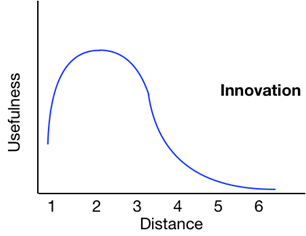
What is not so obvious is how distance aids innovation. The people around us help us get things done, but they are not so useful for when we need to do things differently - come up with new ideas. They mostly know what we know, at about the same time. Innovation requires new ideas and different thinkings, but not too different. Here again context is key. We need people who mostly share our context but reside in nearby locations in the network. Those in adjacent neighborhoods will have different ideas, hear alternate approaches and opinions and will have different histories to the similar topics.

The benefit of adjacency is that these neighbors are different, but not too different. You have much in common and can talk a similar language and share similar experiences. As I tell my clients and students: “Connect on Your Similarities, and Benefit from your Differences”.
These network neighbors are within your network horizon, so you can see them, watch them, learn, and maybe be introduced to them at the right time by a friend or colleague in common. The sweet spot for innovation appears to be those who are currently two to three steps away from you. When looking for opportunities do not look in your back yard, visit adjacent neighborhoods. Figure 4 shows where the “just right” Goldilocks solutions are in one’s network.
It appears that in human networks it is the one, two, and three step paths that matter. Although in real human networks there are many paths that are longer than three. What flows on these paths? Is it noise? Our maybe incomplete flows? A message starts at one end of a nine step path and starts moving forward, but at the fourth or fifth step it reaches a context boundary and the message never gets across, it is dropped. So, the nine-step path is there but things never flow the whole distance they just utilize the path for shorter trips? Get on at step 1 and get off at step 3, get on at step 5 and get off at step 8, and so on.
These are all shorter paths that are utilized and should be paid attention to. The nine-step paths might just be background structures that are never fully utilized? Maybe we look at the nine-step path as several overlapping shorter paths that are utilized. We saw how quickly messages get distorted through just three re-tells. Can you imagine the distortion of the message after 9 relays?
We will investigate how what we have learned affects network metrics in part three.



