
Distance in Human Networks. Part one


With this blog post, we begin a new three-part series by network analysis expert and (R)E-TIES researcher Valdis Krebs on distance in human networks. In the first post, the researcher explores how distance in human networks limits influence and information flow beyond a three-step horizon while increasing message distortion due to contextual differences.
When we join a network, we think we can quickly get anywhere in the network and access all the information and knowledge we need, no matter where it is in the network.
Look at the network below in Figure 1. It is an actual network of a small technology business. Assume you are the red node on the left side of the diagram. Your direct, one-step contacts are the yellow nodes. These are the people you mostly work with to get your job done. Your two-step contacts are the green nodes, which are connected to the yellow nodes. These people influence your work and provide information and knowledge that is not immediately available inside your work group. The blue nodes are three steps away and they are only connected to the green nodes. These people probably do not influence how the red node accomplishes their daily tasks. They only influence the red node rarely and indirectly.
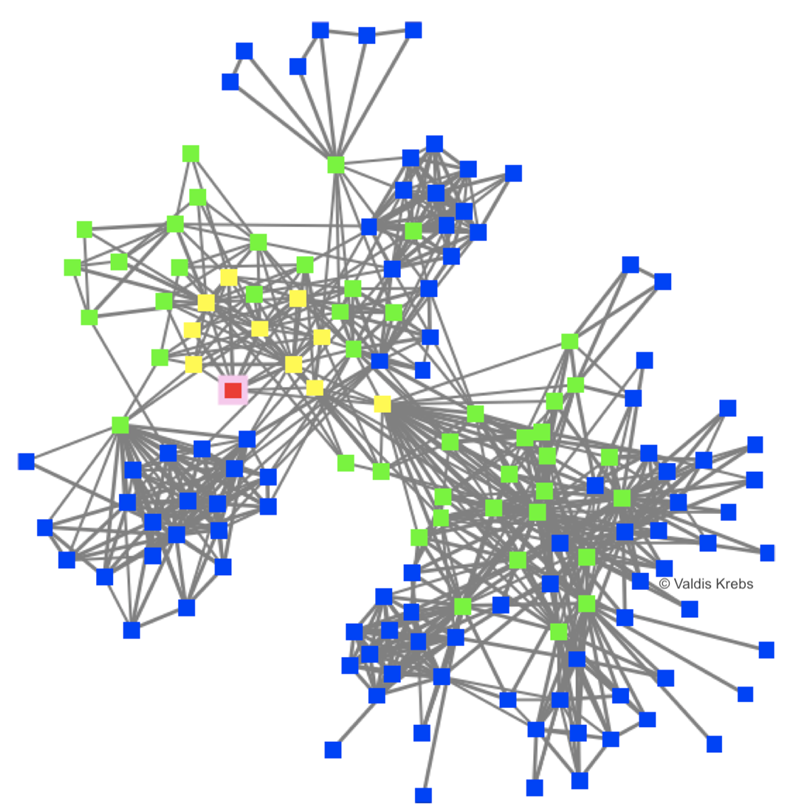
What we notice in networks is that they all have a horizon - the further someone is away from us the harder they are to see and the less useful they are to our daily needs.
Just as we have geographical horizons, we also have distances beyond which we cannot see into our network. Based on the research of Friedkin, Granovetter, and Christakis & Fowler, a network horizon does not go past 3 steps, or 2 intermediaries. Whether you are looking for job, searching for information, trying to find an expert, or aiming to influence others, the limit appears to be 3 steps in your network. Beyond that you are blind and powerless.
Another problem with distance in networks is distortion. As a message travels from person to person it becomes distorted. We all knew this as kids when we played the “Telephone Game”. As a message is told and retold, in a chain of people, it soon becomes unrecognizable by the original teller.
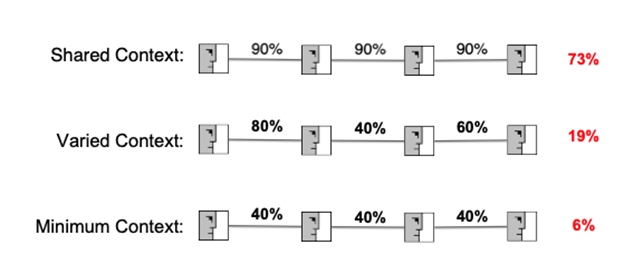
Context between teller and listener of a message affects message distortion. The more two people share the same context (and therefore use the same lingo and have the same history) the better they can communicate and keep the distortion minimized. Figure 2 shows how a message slowly gets distorted with each re-telling. We see how three different contextual environments affect the outcome of the message chain. The percentage number, in Figure 2, between two nodes indicates how much of the message is passed on. In the end we multiply all the percentages to see how much of the original message survives. People telling a message to those they have little in common with soon kill the whole meaning of the message.
Some might say that a message does not distort if everyone gets the same message at once like the same email sent to many. That way, the reasoning goes, everyone reads the same content and no re-telling chain is required for distribution. Direct access - no distortion! No. Again context comes into play to influence the meaning of the message. If two people don’t share the same context, nor have the same history of an ongoing conversation or project they will not interpret the same words the same way.
Each department in an organization has their definitions and internal lingo. I once worked in a large organization where the Human Resources, Employee Benefits, and Finance departments could not agree on a simple term: “employee headcount”. They each had their own rules and came up with 3 different numbers for total headcount. In the end, who was right? They all were. Each department was working under its own rules, policies, procedures and laws. It turns out that “an employee” can be defined in multiple ways with multiple types of employees. These three departments work closely together. Can you imagine the possible misunderstandings in communication between departments that interact rarely and don’t know each other well? Distance can be dangerous - to understanding and agreement. We will explore more in Parts Two and Three.



