Your waistline may tell more than scales: what you need to know about visceral fat


Imagine two people – both are the same height, weight and have almost identical body mass index (BMI). Yet, ten years later, one develops type 2 diabetes, high blood pressure and fatty liver disease, while the other remains metabolically healthy.
Writer: Gita Erta, MD, PhD, endocrinologist
Why can two people with the same body mass differ so much in terms of metabolism?
The answer often lies not in how much fat the body contains, but rather where it is accumulated. Modern medicine is increasingly paying attention not only to body weight but also to the distribution of fat in the body, as this is what largely determines the risk of developing cardiovascular disease, type 2 diabetes and other metabolic diseases.1, 2
In my doctoral thesis at Rīga Stradiņš University (RSU), The Link Between Salivary Amylase Functional Activity, Overweight, and Glucose Homeostasis, I studied how diet and individual metabolic characteristics affect glucose regulation and metabolic health.
There is still a widespread perception in society that excess weight can be addressed with a simple equation: eat less and exercise more. Although a healthy diet and physical activity are indeed very important, modern science shows that obesity is a much more complex condition. Adipose tissue is not simply a passive energy store. It functions as an active endocrine organ, releasing hormones and other biologically active substances that regulate appetite, energy expenditure, inflammatory processes and the body’s sensitivity to insulin.³
When there is too much body fat, particularly in the abdominal cavity, this intricate regulatory system begins to function differently – chronic, low-grade inflammation develops in the body and losing weight becomes increasingly difficult. This is why today it is more widespread not just talking about body weight, but about metabolic health.
What exactly is visceral fat?
The body contains three main types of fat tissue: subcutaneous fat, which is located directly beneath the skin; visceral fat, which surrounds the internal organs in the abdominal cavity; and ectopic fat, which accumulates in places where it should not normally be found, such as the liver, muscles or pancreas.
Not all fat is the same. Most people think of subcutaneous fat – the kind you can feel with your hand. However, the fat we cannot see has a much greater impact on health.
This is visceral fat – adipose tissue that accumulates deep within the abdominal cavity around the liver, pancreas, intestines and other internal organs. Unlike subcutaneous fat, it not only stores energy but also continuously releases hormones, inflammatory mediators and signalling molecules that affect almost all of the body’s metabolic processes.3, 4
It is visceral fat that is most closely associated with an increased risk of type 2 diabetes, high blood pressure, lipid metabolism disorders, metabolic dysfunction-associated steatotic liver disease (MASLD; formerly known as non-alcoholic fatty liver disease or NAFLD) and cardiovascular diseases.2, 3
Nowadays, scientists even refer to visceral fat as a kind of inflammatory organ because it constantly maintains low-grade inflammation in the body, which, in the long term, damages blood vessels, the liver and other organs.5
Interestingly, a person can have a normal body mass index while simultaneously having a significantly increased amount of visceral fat. This phenotype is referred to in the literature as TOFI (Thin Outside, Fat Inside) – ‘thin on the outside, but with excessive fat accumulation internally’. Such people often appear healthy, yet their metabolic risk may be just as high as that of people with obesity.² For this reason, it is increasingly emphasised that body weight alone cannot fully characterise a person’s health. It is far more important to understand how their metabolism functions and where the body stores fat.
Visceral fat is dangerous not only because of its quantity, but also because of its location.
It is located right next to the liver, pancreas and other abdominal organs, so the substances it releases can enter the bloodstream very quickly and affect the body as a whole.3
Unlike subcutaneous fat, which primarily serves as an energy reserve, visceral fat tissue constantly releases free fatty acids, hormones and inflammatory mediators. If there is an excess of this fat, chronic, low-grade inflammation develops in the body. A person does not feel this, there is neither fever nor pain, yet this ‘silent inflammation’ gradually impairs metabolism and increases the risk of cardiovascular disease.4, 5 One of the first processes affected by visceral fat is the body’s ability to respond to insulin.
Cells no longer respond to insulin
Insulin is a hormone that helps glucose move from the blood into cells, where it is used to produce energy. However, as the amount of visceral fat increases, cells become less responsive to insulin signals. This condition is known as insulin resistance.4
At first, the pancreas tries to compensate the situation by producing more and more insulin. This works for a while, and blood glucose levels may still remain within the normal range. However, this places an ever-increasing strain on the body. Over time, the pancreas becomes less able to compensate, and both insulin and blood glucose levels rise, significantly increasing the risk of type 2 diabetes.4 This process does not develop overnight; it progresses gradually, often over several years.
Visceral fat and insulin resistance form a mutually reinforcing cycle. The more visceral fat accumulates, the more it releases biologically active substances that reduce the body’s sensitivity to insulin. Elevated insulin levels, in turn, promote further fat accumulation, particularly in the abdominal cavity. This creates a vicious cycle – more visceral fat leads to greater insulin resistance, while insulin resistance, in turn, promotes even more fat accumulation.3 Many patients say: ‘I am eating less than I used to, but my weight does not change,’ and this is not merely a matter of willpower. The body has reached a state in which it stores energy much more efficiently than it uses it.
Visceral fat acts as an active ‘factory’ for hormones, releasing a range of signalling molecules that regulate appetite, energy expenditure and inflammatory processes.4
As the amount of visceral fat increases, the levels of adiponectin – a hormone that promotes insulin sensitivity and protects blood vessels – decrease. At the same time, leptin levels rise, but the brain becomes less sensitive to this signal. Although there is sufficient energy in the body, the sense of satiety diminishes and appetite remains elevated. This phenomenon is known as leptin resistance.4 As a result, the body simultaneously stores more fat, less efficiently utilises glucose and maintains chronic inflammation – three processes that substantially increase the risk of cardiometabolic disease.
Can visceral fat be measured?
The answer is yes. The most accurate way to assess the amount of visceral fat is through imaging test such as computed tomography, magnetic resonance imaging or DEXA body composition analysis.
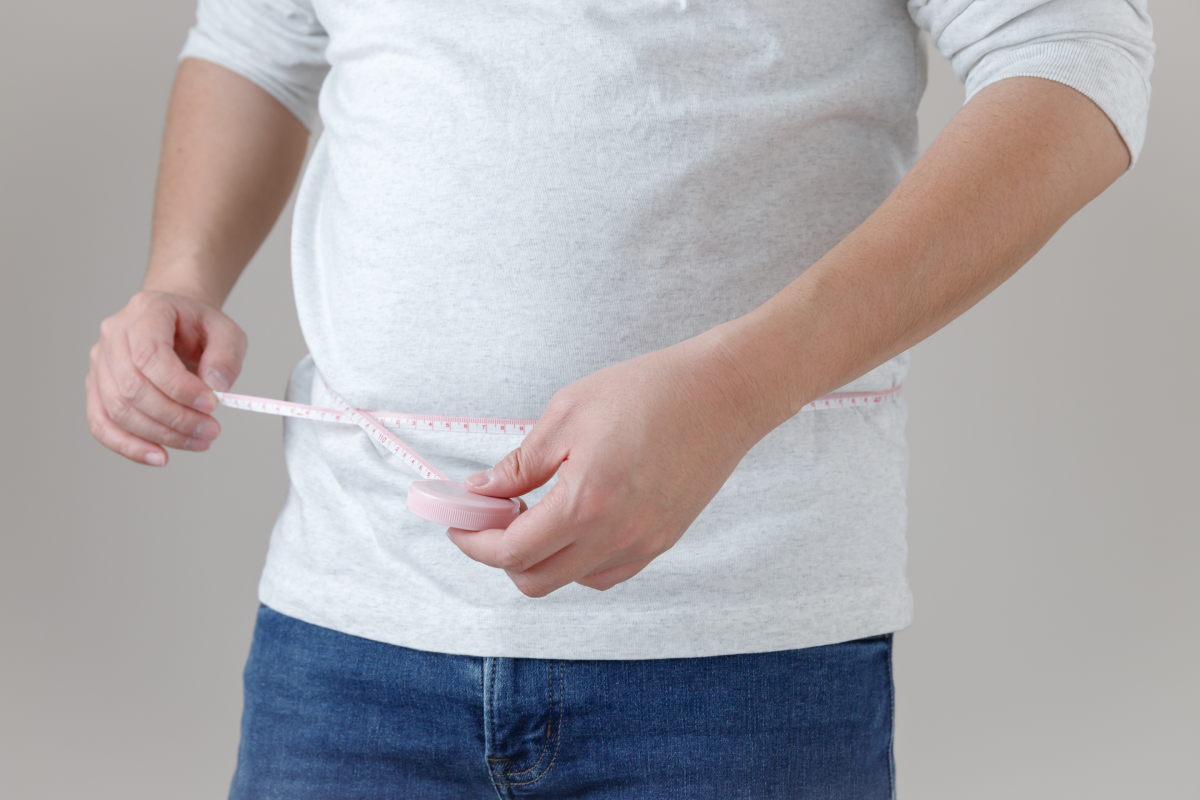
A much simpler, yet surprisingly informative indication of potential cardiometabolic risk can be provided by measuring waist circumference. Often, this tells the doctor more than body weight or even body mass index.
Studies show that the amount of abdominal fat is more closely associated with elevated triglyceride levels, lower levels of good or HDL cholesterol, high blood pressure and the development of atherosclerosis than overall body weight.1, 3, 5 This means that a person may not show any visible signs of obesity, yet they have an increased risk of developing cardiovascular disease. For this reason, doctors are increasingly recommending monitoring not only body weight but also waist circumference.
Why does fat accumulate around the abdomen?
For some people, fat accumulates mainly on their hips and thighs, while for others around the abdomen, and this is not a random process. The fat distribution in the body is determined by a complex interplay of hormones, genetics, age and lifestyle.
One of the key factors is cortisol, a hormone often referred to as the stress hormone. In the short term, it helps the body adapt to stressful situations, but persistently elevated cortisol levels have a different effect, they stimulate the appetite, intensify cravings for sweet and high-calorie foods, and promote the accumulation of fat particularly in the abdominal cavity.
Chronic stress is not merely a psychological problem, but can also be one of the biological mechanisms contributing to an increase in visceral fat.
Sex hormones also play an important role in fat distribution. For women of reproductive age, oestrogen promotes fat accumulation mainly in subcutaneous tissue, around the hips and thighs. During menopause, oestrogen levels fall, and fat distribution gradually changes, with more fat accumulating around the abdomen. This is one of the reasons why many women experience an increased risk of central obesity and cardiometabolic disease after menopause. Changes in testosterone levels also affect body composition and fat distribution in both women and men.
Insulin also plays a significant role. After eating, this hormone helps glucose enter cells and provides the body with energy; however, when insulin levels remain elevated over a prolonged period, the body increasingly shifts towards storing energy rather than using it. This promotes fat formation while inhibiting the use of fat already stored. Visceral fat tissue is particularly responsive to this signal, making hyperinsulinaemia one of the key mechanisms contributing to the development of central obesity and perpetuating the vicious cycle between obesity and insulin resistance.2
How diet, exercise and sleep can help
Although visceral fat is metabolically active and can have a significant impact on health, it is also one of the types of fat that responds best to treatment and lifestyle changes.
Regular physical activity improves the body’s sensitivity to insulin and helps reduce fat accumulated specifically in the abdominal cavity – often even when the body weight remains largely unchanged.1, 4 Strength training, aerobic exercise and interval training have a particularly beneficial effect. However, the most important factor is not the specific type of exercise, but their consistency. Even moderate physical activity, if it becomes a daily habit, significantly improves metabolism in the long term.
Excessive consumption of ultra-processed foods, sugar-sweetened beverages, refined carbohydrates, and added sugar promotes the accumulation of visceral fat and exacerbates inflammatory processes. Conversely, a diet rich in vegetables, legumes, whole grains, high-quality protein and fibre helps improve metabolism and reduce visceral fat.2
Eating habits in general also play an important role.
Regular meals, an adequate intake of fibre and reduced consumption of ultra-processed foods help maintain more steady blood glucose levels and reduce the need for excessive insulin secretion.
Sufficient sleep and stress reduction are equally important. Chronic sleep deprivation and prolonged stress disrupt the functioning of appetite-regulating hormones, promote insulin resistance and contribute to fat accumulation around the abdomen.6 People tend to view sleep merely as a form of rest, but in reality, it is one of the most important regulators of metabolism. At the same time, hormonal activity changes – satiety decreases, while hunger and cravings for sweet or fatty foods increase. As a result, after a sleepless night, we often eat more without even realising it.
Even just a few nights of insufficient sleep can reduce the body’s sensitivity to insulin.6
Studies show that people who consistently sleep less than six hours a night are more likely to have increased levels of visceral fat and a higher cardiometabolic risk.6 And it is not only the duration of sleep that matters but also the quality. Frequent waking during the night or an irregular sleep pattern can affect metabolism in much the same way as a lack of sleep.
Meanwhile, for patients with obesity, modern medication therapy is also playing an increasingly important role. It is not intended for aesthetic purposes but rather for the treatment of a chronic disease, helping to reduce visceral fat, improve metabolic health and lower the risk of type 2 diabetes and cardiovascular disease.
Obesity is a multifactorial disease
Modern medicine is gradually changing the view of obesity. In the past, the main question was: ‘How much does a person weigh?’, whereas today, the question ‘How is their metabolic health?’ is asked more frequently. Two people with the same body weight can have completely different levels of inflammation, insulin sensitivity and risk of cardiovascular disease.1,2 Therefore, increasing attention is being paid not only to kilograms but also to the distribution of fat in the body, particularly visceral fat.
Obesity is not a weakness of character or a sign of laziness, but rather a chronic, multifactorial disease involving genetics, hormones, the nervous system, the environment and lifestyle.
This does not mean that people have no control over the situation. On the contrary, the better we understand the biological mechanisms, the more effectively we can treat them.
Of course, improving metabolic health is not always easy. If you are unable to change your habits or achieve the desired result on your own, it is worth seeking professional support. Effective, scientifically-based solutions for personalised treatment and prevention are available today.
The findings of the doctoral thesis showed that metabolism is much more individual than previously thought.
This understanding opens up opportunities for personalised medicine – an approach where prevention and treatment are tailored to the specific characteristics of each person’s metabolism, rather than based solely on body weight and standardised recommendations.
The article was first published on the LSM portal.
References
1 Després JP. "Body fat distribution and risk of cardiovascular disease: an update". Circulation. 2012 Sep 4;126(10):1301-13. doi: 10.1161/CIRCULATIONAHA.111.067264. PMID: 22949540
2 Neeland IJ, Ross R, Després JP, Matsuzawa Y, Yamashita S, Shai I, Seidell J, Magni P, Santos RD, Arsenault B, Cuevas A, Hu FB, Griffin B, Zambon A, Barter P, Fruchart JC, Eckel RH; International Atherosclerosis Society; International Chair on Cardiometabolic Risk Working Group on Visceral Obesity. "Visceral and ectopic fat, atherosclerosis, and cardiometabolic disease: a position statement". Lancet Diabetes Endocrinol. 2019 Sep;7(9):715-725. doi: 10.1016/S2213-8587(19)30084-1. Epub 2019 Jul 10. PMID: 31301983
3 Fox CS, Massaro JM, Hoffmann U, Pou KM, Maurovich-Horvat P, Liu CY, Vasan RS, Murabito JM, Meigs JB, Cupples LA, D'Agostino RB Sr, O'Donnell CJ. "Abdominal visceral and subcutaneous adipose tissue compartments: association with metabolic risk factors in the Framingham Heart Study". Circulation. 2007 Jul 3;116(1):39-48. doi: 10.1161/CIRCULATIONAHA.106.675355. Epub 2007 Jun 18. PMID: 17576866
4 Kahn SE, Hull RL, Utzschneider KM. "Mechanisms linking obesity to insulin resistance and type 2 diabetes". Nature. 2006 Dec 14;444(7121):840-6. doi: 10.1038/nature05482. PMID: 17167471
5 Shulman GI. "Ectopic fat in insulin resistance, dyslipidemia, and cardiometabolic disease". N Engl J Med. 2014 Sep 18;371(12):1131-41. doi: 10.1056/NEJMra1011035. Erratum in: N Engl J Med. 2014 Dec 4;371(23):2241. PMID: 25229917
6 Ogilvie RP, Patel SR. "The epidemiology of sleep and obesity". Sleep Health. 2017 Oct;3(5):383-388. doi: 10.1016/j.sleh.2017.07.013. Epub 2017 Aug 15. PMID: 28923198; PMCID: PMC5714285