
‘Science needs freedom of thought’. Meet Tenured Professor Maija Radziņa


Writer: Linda Rozenbaha, RSU Public Relations Unit
‘At present, technologies are closely intertwined in a natural symbiosis to achieve the overarching goal, which is a personalised approach in medicine. This is where each individual’s unique characteristics are taken into account. The combination of technologies enables us to address situations on an individual level: artificial intelligence (AI) solutions allow us to process a much larger volume of data, surpassing human capacity both in terms of working hours and physiological brain capabilities,’ says Maija Radziņa, Tenured Professor at the Rīga Stradiņš University (RSU) Department of Radiology. She joins us for a conversation about the potential of AI in medicine and her research using AI solutions in cancer and stroke diagnostics.
Continuing the series of articles about RSU tenured professors, we introduce Maija Radziņa’s journey and passions in medicine and science.
When talking to doctors or other specialists about the use of AI in healthcare, it is often joked that radiology could be the first specialty to disappear. Yet, your research focuses precisely on how to apply AI in radiology in a more meaningful way.
To answer this question, let’s take a brief look at history. In the 1970s, radiology was the medical field where the medical technology of the time, the X-ray, was closely combined with computing or computer technologies. This led to a method called computed tomography. This is also when the profession changed from X-ray specialist to radiologist.
Our field has always kept pace with technological advances. The claim that we will be the first to be replaced by AI is, I believe, a misinterpretation of actual events.
In fact, we have the greatest experience, over 50 years to be exact, in introducing and integrating computer-assisted technologies in our field. At some point, computer-assisted diagnostics was renamed as AI, which has today taken on a broader meaning.
And how did you get into radiology? You have a background both in medicine and in law…
I had already decided in the 10th grade that I would study medicine, and then I took decisive action to achieve my goal – I studied chemistry in addition to my regular classes and did everything to be well-prepared. However, when I was already in my 3rd year of medical studies, in the 1990s, I experienced a certain stagnation and loss of motivation, as there was no funding at the time. Moreover, we were strongly encouraged to choose family medicine (a new field back then), but this was not what I was interested in. During this period, a group of my peers and I also enrolled in a law programme, so I obtained both degrees at the same time.
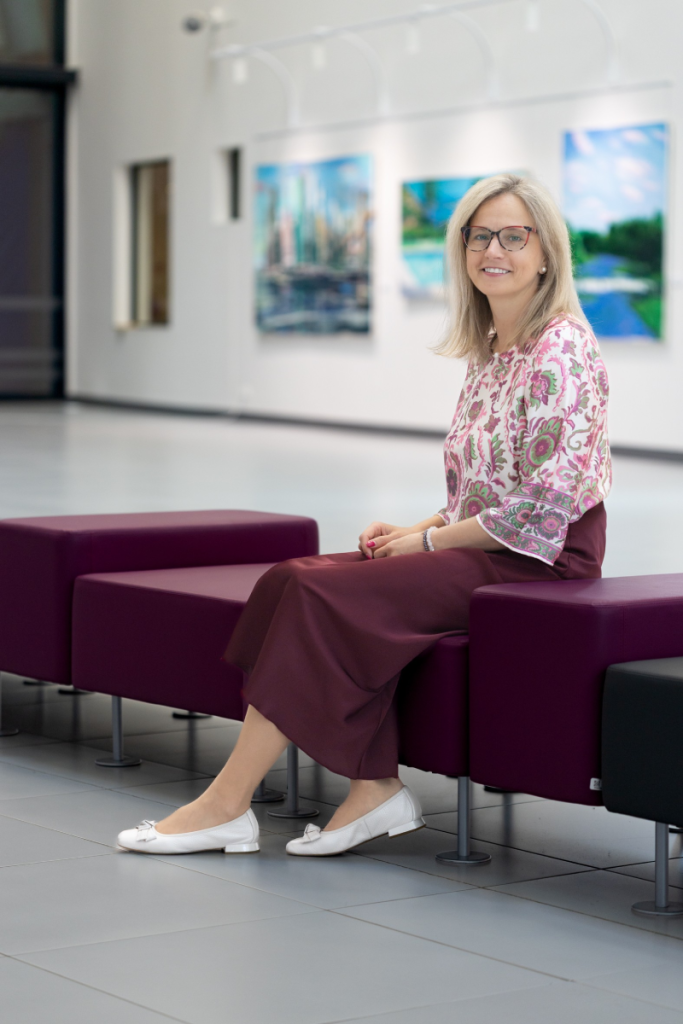
Tenured Professor Radziņa
I completed my 2nd–3rd years in law while in my 4th–6th year in medicine. I continued my law studies and went on to receive a master’s degree during my radiology residency.
Sometimes during my examination periods, I would take medical exams in the morning and law exams in the evening. That is probably something one can only manage when you’re young.
I have never taken a break from my education. I had two children during my doctoral studies, but I did not take any academic leave.
But why did I choose radiology? We had wonderful lecturers, and I submitted my application for both radiology and surgery, but in the end, I chose the former. Radiology seemed very interesting, and at that time it was a rapidly developing field in Latvia. Computed tomography was widely used, and magnetic resonance imaging was advancing, both of which have now become fundamental in radiology. I am grateful to the lecturers who sparked my interest! For example, Aija Teibe, Ausma Ozoliņa, Elizabete Kadakovska, Tatjana Ozola, Prof. Gaida Krūmiņa, Prof. Ardis Platkājis, and others. Each of them has been an inspiration. I also have fantastic colleagues in my daily work. Some have taught me excellent practical skills, while others have inspired me to pursue my research ambitions. These people have been a source of inspiration on my journey, which is why I have chosen to focus on certain fields more deeply.
At present, I have chosen to focus more on abdominal vascular and oncological radiology. I also work in vascular, nervous system and musculoskeletal radiology.
How did you engage in research alongside your clinical work?
I did my first small research project before my doctoral studies around 2004 (I started my doctoral studies in 2010 and completed them in 2014). I was inspired by my colleagues who, before we went to a European-level conference, said that we could not just go to listen, but that we had to submit a research abstract.
This first experience in research sparked my interest!
The next major inspirational moment was an internship I underwent in the United States in 2007, at Massachusetts General Hospital in Boston. There, I learned about emergency radiology, including CT perfusion of the brain in patients with acute ischemic stroke, and soon after, we began performing these examinations at our hospital. I was already working at Pauls Stradiņš Clinical University Hospital at that time. These examinations were not part of routine clinical practice and were not yet included in guidelines, but rather performed experimentally. After my visit to the US, my commitment to research was firmly established, which led me to enrol in a PhD programme at RSU. New methods cannot be introduced without an excellent team! I was fortunate in this regard. I met the right people, at the right time and place, to introduce CT perfusion imaging of the brain in Latvia, together with neurologists and interventional radiologists.
A great source of satisfaction today is that the CT perfusion methods that I pioneered together with my team have become established in medicine. My younger colleagues often do not even realise that they are working alongside the people who introduced these methods into practice.
You have been a tenured professor at RSU since April this year. What advantages has this brought to your research?
In my academic career, I had become a lead researcher at RSU.
I am honoured to have been appointed a tenured professor. This position has only relatively recently been established in Latvia, so I feel like a beginner, as there are no predecessors to follow. I have to follow my own path!
A tenured professor is a research professor, and I am truly interested in research. This position has given me a foundation under my feet and, to some extent a sense of freedom and self-determination. Of course, a like-minded group of colleagues is also extremely important.
Even if we deal with natural sciences, there is always a creative aspect that requires freedom of thought and freedom of time, and I believe this is what the position of tenured professor can offer. I have the opportunity to develop freely; one just has to find the right direction, opportunities, and fields. I see the relevance of research in the field of AI. Since the pandemic, many digitalised solutions have become part of our daily lives. Yes, we used them before, but the pandemic accelerated everything, giving a different level of efficiency and resonance. To some extent, I also associate this with the introduction of AI into medicine. We already had smartphones and many other tools, but now, thanks to the latest solutions, we have a much stronger and more versatile capacity. But this capacity needs direction, leadership, and clear priorities – a role for scientists. It is not a guarantee that researchers will provide all the answers immediately, but we can find the right, most effective path. Most importantly, we should find a way to involve our colleagues in using technology in healthcare and medical development so that knowledge does not remain only at the user level, but is applied to change the world, even if just by one degree.
Please tell us more about your research aspirations as a tenured professor!
Before I discuss AI research, I want to emphasise
that “AI” is not entirely the correct term, because we are not creating anything artificial. In medicine, we work with real information, real data, and real images. We modify, improve, and accelerate certain processes. The more accurate terms would be “augmented reality” or “augmented intelligence”, rather than AI.
[Augmented reality is technology that supplements the real world with digital elements, author’s note] To emphasise: in radiology, these technologies have now merged naturally into a symbiosis that serves the main goal – achieving an individualised approach to medicine. Computer technology is a useful assistant. We are currently at a stage where we must determine which technologies can help us most effectively, because there is a large supply at various stages of development. Not only has the IT sector delved into medicine, but medical professionals are also now assessing which innovations are worth adopting to achieve the main objective – streamlining certain tasks and working more efficiently.
For example, AI is integrated into the workflow in radiology, to help prioritise or determine the significance of certain cases. This is hugely important in emergency medicine. AI can calculate, measure, and compare. Tasks that would take me several minutes are completed automatically, dispassionately, and much faster by AI. For instance, in a screening programme, AI can highlight the data that requires my attention. AI cannot make decisions for me, but it is very good at performing technical tasks.
All of these technologies have been created by us, humans. We select data sets, mark specific indicators – a tremendous amount of work has been done and is being done. It is an illusion to think that feeding large data sets into AI will automatically produce miracles. That is not how it works.
Of course, one could partly agree that AI poses a potential threat to the necessity of our work. Consider, for example, if driving were to become fully automated – drivers might no longer be needed in the future, and we could even lose the ability to drive ourselves. The question is: how much can we trust technology? This is especially critical in medicine, where we entrust our own health and lives, as well as those of our loved ones... This is why research is essential. Scientists’ work serves as a transitional stage: on the one hand, we develop new programmes, and on the other, we test the real-world usefulness of the programmes we have created.
We are currently working on a study focused on diagnosing bone metastases, particularly in the spine, where distant cancer metastases frequently occur. We are investigating how they could be identified more quickly using AI software solutions.
This would mean that we would no longer need to locate and measure each metastasis manually, as AI could perform these tasks and analyse the results. We are also studying the use of AI in acute stroke patients. In a sense, this builds on the topic of my dissertation from over ten years ago, but now we are exploring AI solutions in a different context and with a new approach.
Although it is a little painful to realise that tasks I used to carry out manually for hours ten years ago can now be completed by AI in minutes, I also deeply appreciate the progress we, scientists, have achieved through collaboration.
In the stroke study I mentioned, AI gives us valuable time – and time is precisely what these patients need, as every minute counts. We can prevent brain damage by providing timely intervention. If AI tools can improve and accelerate the care delivered, helping a patient regain functional quality, then the main objective has been achieved.
Similarly, the earlier and more easily we can detect certain forms of cancer, the better – particularly those that develop without obvious symptoms. By providing large data sets and using carefully formulated commands, we enable the system to search for patterns. For example, we may be able to identify early forms of cancer by selecting the five most important characteristics. This is complex scientific and analytical work, which we are currently undertaking.
Who is on your research team?
Currently, our research team includes radiologists and IT specialists. We also collaborate with several institutions, including the Institute of Electronics and Computer Science, as well as clinical hospitals such as Pauls Stradiņš Clinical University Hospital and Riga East University Hospital. Our partners include specialists in AI software, along with clinical staff, like neurologists, oncologists, spine specialists, and others.
Our goal is to develop technological solutions that are relevant not only in Latvia, but also internationally.
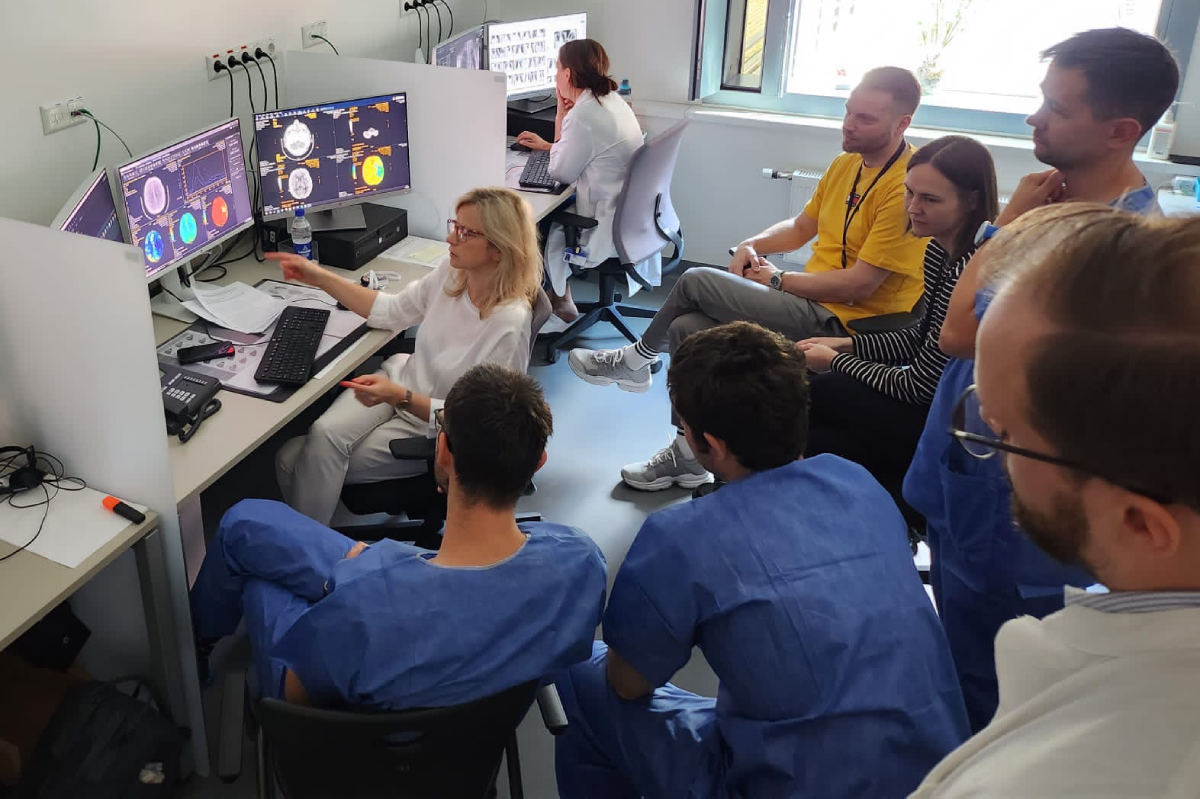
Tenured Professor Radziņa with her team
It is clear how vitally important it is to detect cancer at an early stage. But are there areas where the detailed diagnostics enabled by technology can also carry risks? For example, in a conversation with Ilze Maldupa, Lead Researcher in Dentistry at RSU, she highlighted the risk that detecting very minor tooth damage could lead to premature or overactive treatment. I recall older dentists who recommended waiting before treating a tooth because the cavity was still very small. Yet, there are doctors who prefer to “take the bull by the horns” immediately.
There are areas where, in my opinion, the traditional approach remains effective, and others where progress has led to changes in attitudes and improved care. For example, teeth can be treated without anaesthesia, but a patient’s experience and treatment adherence can improve because they have a choice and the option to minimise discomfort.
At the same time, there are technologies whose use can also create unnecessary stress. For instance, many healthy people use smartwatches to monitor their heart rate. Occasionally, the readings may be irregular, which the watch reports. This can cause anxiety, even though the person is healthy and occasional irregularities are normal.
At the age of 50, one must start attending a relatively large number of screening programmes (for the mammary glands, cervix, prostate, intestines), even if there are no complaints. Yet the stress or anxiety experienced before each examination contributes to even greater anxiety... It is difficult to say where the line between too much and too little assessment lies.
It has long been established that elevated stress levels lead to increased anxiety, and a persistent, unresolved state of anxiety is detrimental to health. Do endless tests bring us closer to well-being? I do not believe they do.
AI solutions can also be extremely useful here, particularly in their predictive capacity. For example, by taking into account a person’s age, level of physical activity, genetic factors, and other indicators, it is possible to create so-called “roadmaps” – scenarios that illustrate how specific actions can reduce various health risks by a certain percentage.
In this way, individuals become better informed and can make conscious decisions about their lifestyle to reduce risks and promote well-being. The goal is not merely to live a long life, but to maintain the highest possible quality of life. Long-term illness is both physically demanding and economically costly – for individuals as well as for the entire healthcare system, whose expenses continue to rise.
Can AI solutions help recover these economic investments? Possibly, if they are used wisely.
How do you take care of your personal well-being, and what are your hobbies?
I am passionate about many things!
I enjoy being active – I would even say that activity is synonymous with my personality.
I feel great when running, walking, or enjoying water-based activities, such as sailing.
I also enjoy travelling and discovering new cultures, which helps to broaden my horizons. My research work has given me additional opportunities to explore the world.
To conclude our conversation, how do you see RSU developing in the future?
My feeling, concerning not only RSU but Latvia in general, is that we do excellent work and have outstanding research, which deserves broader recognition. We already work at a very high level, but we must make even greater effort to reach the right channels and platforms to ensure that our research is noticed and acknowledged.
To promote ourselves more on broader scale, we need cooperation – friendships. Such friendships are possible because people are willing to collaborate. We simply need to ask. We must work hard so that we are not only the ones extending invitations, but also receiving them. Of course, sometimes this begins with us taking the first step.
I have received only positive feedback regarding the way we organise work in Latvia – both in terms of efficiency and quality, including the implementation of European projects.
We have a strong work ethic; our people are diligent, efficient, and genuinely engaged.
We could certainly achieve even greater local and international success if we learned to foster friendships among universities and hospitals and created joint Latvian projects. We already have excellent inter-university cooperation in the development of digital competencies and the AI programme under the leadership of Agrita Kiopa. I am grateful for these opportunities, as they have enabled me to collaborate closely with colleagues from both the University of Latvia and Riga Technical University. I truly believe there should be more projects like this.
AI solutions offer significant opportunities to build creative, interdisciplinary teams, and I am grateful for the chance to study and develop this area within medicine.
Related news
 RSU hosts CNRS/EHESS Centre for Russian, Caucasian, East European and Central Asian StudiesResearch, International Cooperation


