
RSU Professor Dzintra Atstāja presents study on integrating sustainable development goals into education


At the conclusion of the European Sustainable Development Week, on 6 October, a seminar “10 years together on the path to sustainability in Europe” was held at the State Chancellery. During the event, Prof. Dr. oec. Dzintra Atstāja, Lead Researcher at the Faculty of Social Sciences of Rīga Stradiņš University (RSU), Corresponding Member of the Latvian Academy of Sciences, and Expert of the Latvian Council of Science, presented the results of the research “The New Paradigm in Education – Changing Values and Integrating Sustainable Development Goals into the Study Content.”
The aim of the study was to assess the integration of the UN Sustainable Development Goals into the study content and the change in values as a result of environment and business education.
The study involved experts from Latvian research universities (RSU, the Riga Technical University, the University of Latvia, and the Latvia University of Life Sciences and Technologies), public sector institutions (the State Chancellery, the Ministry of Education and Science, the Latvian Council of Science), as well as non-governmental organisations and the Latvian National Commission for UNESCO. Focus groups were formed with social science students from five Latvian universities.
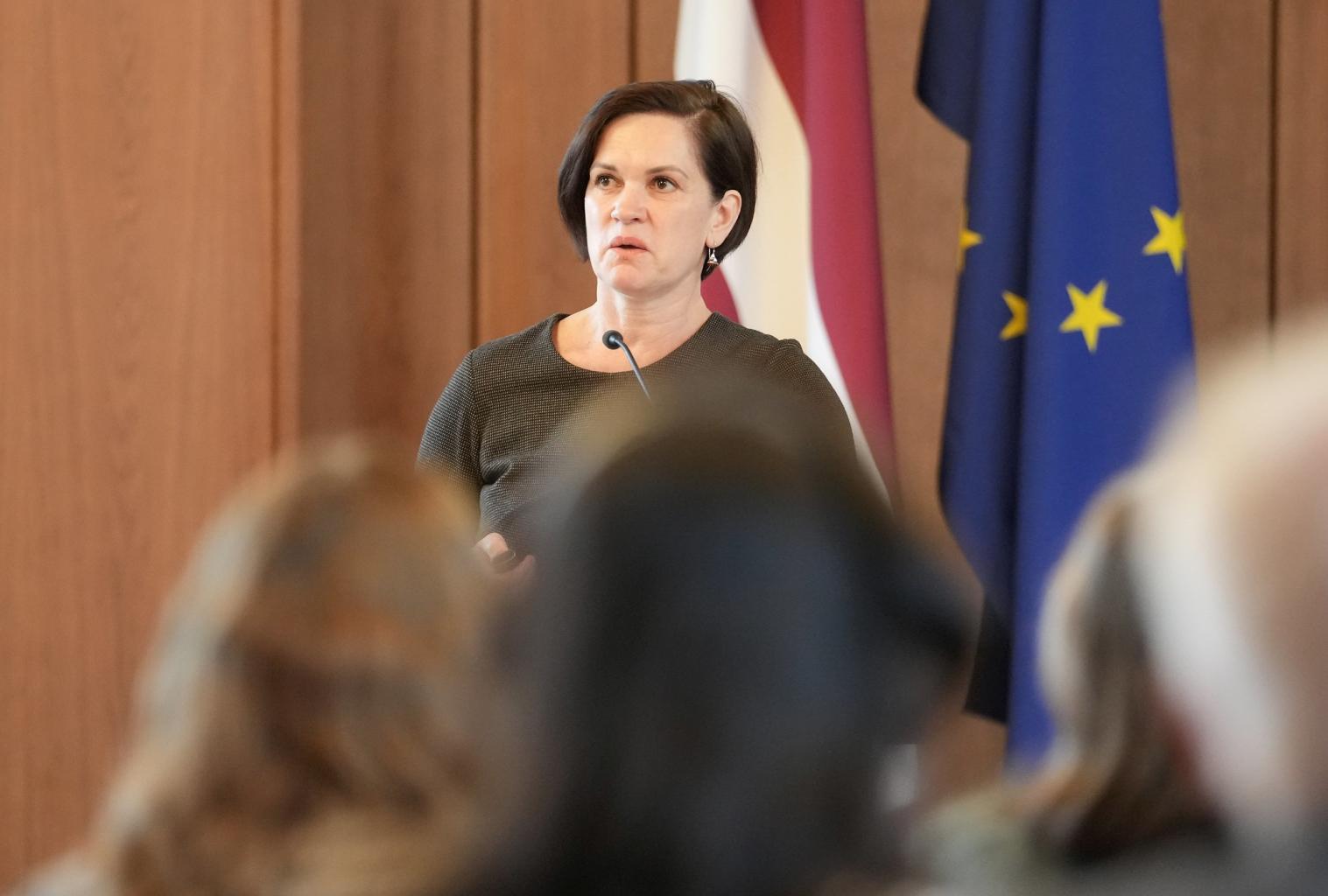
Prof. Dzintra Atstāja during her presentation
The research used a mixed-methods approach, combining expert interviews, quantitative data collection through online surveys, and qualitative data collection through focus group discussions. This approach has ensured data diversity, validity, and analytical depth.
Expert interviews provided a strategic perspective on the integration of the Sustainable Development Goals (SDGs) in education, the focus group discussions revealed nuances in students’ understanding and attitudes, while the quantitative surveys provided a broad empirical foundation.
The results of the study show that the integration of the SDGs into higher education programmes in Latvia is fragmented — approaches across universities and sectors vary from superficial to in-depth. Experts also lack a common understanding of whether sustainable development should be defined as a separate subfield within the social sciences or maintained as a cross-cutting approach.
Recommended steps for strengthening sustainability in education
- Develop more interdisciplinary courses that incorporate environmental, social, and governance aspects;
- Strengthen the competence of academic staff in sustainability-related issues;
- Integrate SDG research directions into the strategies of higher education institutions;
- Promote collaboration among employers, students, and the academic community in the development of sustainability courses;
- Expand the content of the mandatory environment protection course to include sustainable development topics;
- Develop a unified quality management framework for evaluating the implementation of the SDGs.
Prof. Dzintra Atstāja emphasises that ‘universities play a significant role in promoting sustainable development within society, and their contribution is linked to the knowledge, skills, and values of the future professionals. Thanks to the responsiveness and engagement of colleagues, comprehensive information has been obtained about the actual situation in Latvian higher education institutions. This is a success story, and this interdisciplinary research project is already contributing to the integration of the Sustainable Development Goals into the study programmes and activities of higher education institutions. By promoting examples of good practice, we will encourage the change in habits and awareness of the importance of the UN Sustainable Development Goals in everyday life.
The European Sustainable Development Week is an appropriate time to encourage and inspire the public to act sustainably, share experiences, and strengthen a common understanding of how to build a future that is economically, socially, and environmentally friendly.’
Related news
 RSU strengthens its leadership in the Baltics and climbs in the global sustainability rankingsSustainable Development, For RSU Employees, Rankings, For Students


