
RSU organises #ErasmusDays 2025


From 13 to 18 October, #ErasmusDays 2025 took place across Europe. Over the course of six days, Erasmus+ project implementers and professional networks from all sectors of education organised a variety of events highlighting European cultural diversity and the richness of mobility, the benefits of mobility, and the results of Erasmus+ projects. Rīga Stradiņš University (RSU) organised three online seminars during #ErasmusDays.
On 14 October, a seminar dedicated to Erasmus+ staff mobility opportunities took place, during which RSU academic and administrative staff shared their Erasmus+ experiences in an informal atmosphere. Speakers included Ieva Kalve from the Faculty of Social Sciences, Andrejs Šitovs from the Faculty of Pharmacy, Dzintars Brūvers from the Human Resources Department, Ilze Zvēra from the International Department, Kaspars Zaltāns from the Anatomy Museum, and Rudīte Koka from the Faculty of Medicine. Some seminar participants already have 15 to 20 years of Erasmus+ experience, which confirms the usefulness and opportunities offered by international mobility.
The speakers particularly highlighted the innovations introduced through mobility and the good practices adopted from cooperation partners. For example, the mobility experience has not only enabled Andrejs Šitovs to conduct practical experiments and gain new research experience but has also resulted in several scientific publications. Meanwhile, Kaspars Zaltāns introduced nearly 50 seminar participants to the successful practice adopted from Amsterdam’s Frolik Museum, which involves engaging student ambassadors as guides at the RSU Anatomy Museum. There are currently 20 student guides working at the Anatomy Museum, whose tours are particularly popular among their peers.
At the end of the seminar, Rudīte Koka encouraged her colleagues to take up the challenge and embark on collaborative projects with international partners, as such an approach opens many doors to new ideas, innovation, and development.
Seminar on Blended Intensive Programmes
On 15 October, the seminar focused on Blended Intensive Programmes (BIPs), a relatively new form of international cooperation and Erasmus+ mobility that combines online learning with short-term on-site mobility. With its short on-site component, this programme offers a particularly inclusive form of mobility, enabling students and staff members who cannot participate in long-term mobilities to gain Erasmus+ experience.
Ilze Apine and Egita Senakola from the Faculty of Dentistry, and Klāvs Sedlenieks from the Faculty of Social Sciences, shared their experiences of organising BIPs at RSU. The colleagues provided insights into both the practical implementation of BIPs and the challenges involved, encouraging members of the RSU academic staff to take part in organising such mobilities. Representatives from both faculties confirmed that the BIPs they had implemented would certainly not be their last of this kind, as preparations are already underway for the next BIP initiative.
Student inspiration stories
On 16 October, which marked the final day of #ErasmusDays 2025, the seminar focused on students' experiences. Participants looked back on their time abroad, encouraging others to embark on their own Erasmus+ adventure. The audience not only heard inspiring and entertaining stories about students’ mobility experiences, but also received practical advice – both for planning an exchange and for making the most of the time spent abroad.
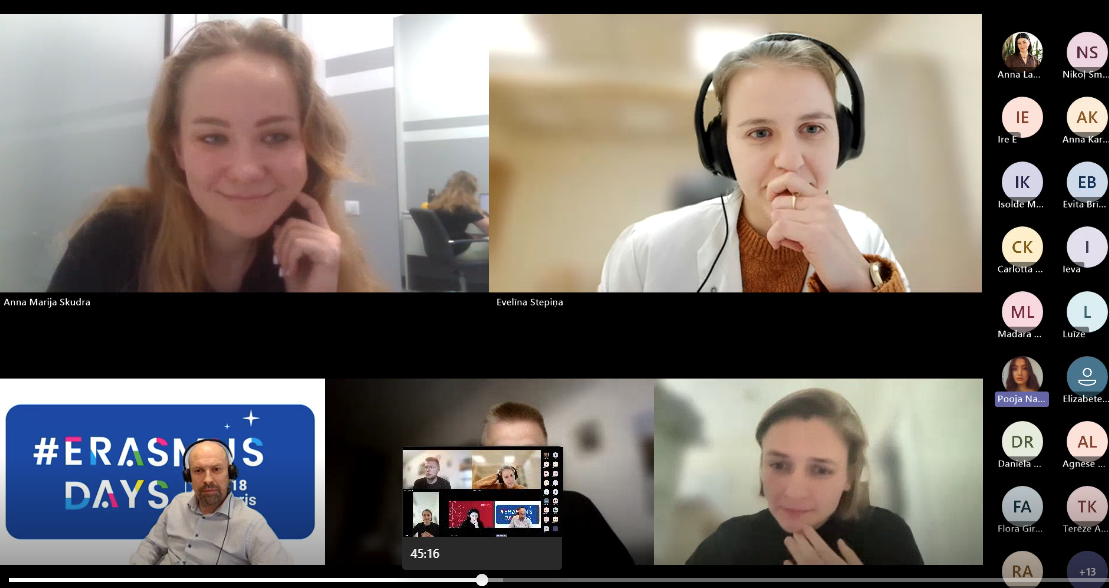
Screenshot of the seminar about students' experience with Erasmus+
Anna Marija Skudra, Eduards Liepiņš, Evelīna Stepiņa, and Isabell Annemarie Elisabeth Freiin Waitz von Eschen shared their Erasmus+ experiences. As with RSU staff representatives earlier in the week, students encouraged their peers to take part in mobility opportunities, which can sometimes bring unexpected yet positive changes. As Evelīna Stepiņa noted during the seminar, ‘Sometimes, all it takes is one conversation to travel to another continent’.
Related news
 RSU strengthens strategic cooperation in medical education and physician training in Germany International Cooperation


