Postpartum depression screening – a new and essential stage in maternal healthcare in Latvia


The postpartum period in a woman’s life is often associated with joy and a new beginning. In reality, however, for some new mothers it is also a psychologically challenging time. Until quite recently, postpartum depression as a public health issue in Latvia had been insufficiently studied and was only recognised in practice in a fragmented way. Public attention to a new mother’s mental health is most often drawn only in severe or crisis situations, yet emotional difficulties much more often go unnoticed and unsupported in time. Professor and leading researcher at Rīga Stradiņš University (RSU), Elmārs Rancāns, puts it even more directly: “Until now, in Latvia’s healthcare system the main focus after childbirth has been on the baby, while the young mother’s mental health and wellbeing have, at best, remained secondary.”
The study carried out by RSU’s Department of Psychiatry and Narcology, in cooperation with Rīga Maternity Hospital, has significantly changed this situation by laying the foundations for the first systematic study of postpartum depression and for the introduction of screening into maternal healthcare.
Unnoticed, yet widespread
For the first time, the RSU study provided scientifically grounded evidence of the scale of the problem in Latvia. Over a period of 12 months, data were collected from 272 women aged 18 to 49, covering more than 80 % of those who attended the compulsory postpartum visit with a gynaecologist at Rīga Maternity Hospital four to six weeks after childbirth. Initial screening showed that around 18 % of women displayed signs of depression, while subsequent in-depth assessment identified the factors associated with postpartum depression.
The in-depth assessment also identified several risk factors linked to postpartum depression. A higher risk was found among women who had experienced childbirth complications, sleep disturbances after delivery, high stress levels during pregnancy, or other mental health conditions, as well as among those who lacked emotional support from a partner or relatives. Lower confidence in the maternal role, dissatisfaction with the care received, and lower newborn birth weight were also significant factors, whereas practical support from a partner or family acted as a protective factor.
These findings confirm that postpartum depression is not a rare phenomenon in Latvia and that its prevalence is similar to that in other European countries, while also underscoring the need for early recognition in routine care.
A study approach tailored to new mothers
The study methodology was designed with the realities of women’s everyday lives during the postpartum period in mind. Screening was integrated into postnatal gynaecological visits using short self-assessment questionnaires to identify symptoms of depression and anxiety. Women with elevated scores were offered in-depth interviews with specialists, most of which took place remotely.
As psychiatrist Marija Lazareva, who was involved in the study, emphasised in an interview, remote interviews helped reduce barriers to participation and made it possible to adapt to women’s demanding daily routines, when attending in-person appointments with a newborn is not always feasible.
Two scientifically validated screening tools adapted to the Latvian context
One of the study’s most significant outcomes is the adaptation, or validation, of two postpartum depression screening instruments for the Latvian population. Until now, Latvia had no depression screening tool specifically adapted to assess the severity of postpartum depression symptoms. During the study, the Edinburgh Postnatal Depression Scale (EPDS) was adapted to Latvian conditions, and researchers established a Latvia-specific cut-off score of 11 or more points. The Patient Health Questionnaire-9 (PHQ-9) was also validated, with eight or more points indicating serious depression.
The study showed that both screening questionnaires are easy to use, quick to complete, and do not significantly increase doctors’ workload during routine visits. The practical accessibility of these tools is an essential precondition for making screening a regular component of maternal healthcare and for helping identify, in a timely manner, women who need additional support.
Multidisciplinary collaboration and a systemic perspective
A broad multidisciplinary team was involved in carrying out the study – gynaecologists, psychiatrists, psychologists and researchers – working in close cooperation with Rīga Maternity Hospital. This collaboration made it possible not only to collect data, but also to model a care approach in which gynaecologists can identify women at increased risk in a timely way and recommend further specialist support.
An important part of the study was also gathering women’s views on a potential new care model. Overall, the participants assessed it positively and emphasised that coordinated cooperation between gynaecologists, family doctors, midwives and psychiatrists could help difficulties to be recognised earlier and ensure the necessary support. At the same time, the women also provided valuable suggestions on how this approach could be adapted to Latvia’s healthcare system.
At the same time, the study also highlighted challenges – some women, even after acknowledging symptoms of depression, declined further consultation. This points to the need to strengthen public awareness and reduce stigma related to mental health during the postpartum period.
A path towards sustainable change
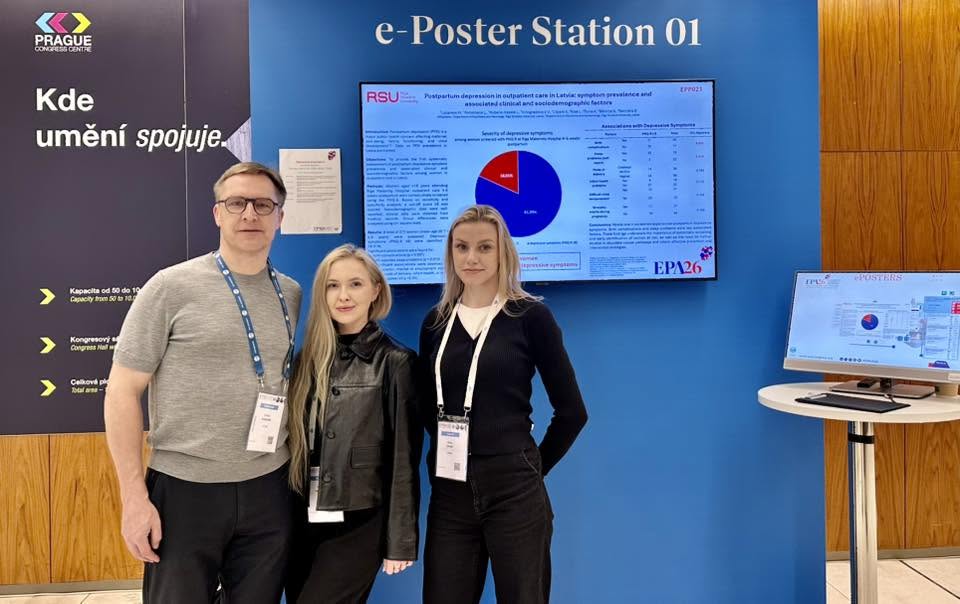
The work of RSU researchers has already been presented at six international conferences and reflected in three scientific publications. Representatives of the Ministry of Health and the State Chancellery have been introduced to the study results, laying the groundwork for the further development of the screening approach. The study marks a new stage in maternal healthcare in Latvia – moving from fragmented recognition of the problem to structured, evidence-based screening that enables timely identification of women who need additional support.
Research team
Psychiatrists
Prof. Elmārs Rancāns
Asst. Prof. Lubova Renemane
Asst. Vineta Viktorija Vinogradova
Dr. Linda Rubene (doctoral candidate)
Dr. Marija Lazareva (doctoral student)
Dr. Silvija Cīpare (doctoral student)
Gynaecologists
Dr. Līva Ķise (doctoral student)
Dr. Kristiāna Šulte
Dr. Laura Ramona Rozīte
Dr. Arta Bērziņa
Iveta Āboliņa
Outpatient gynaecologists of Rīga Maternity Hospital
Psychologists
Prof. Kristīne Mārtinsone
Prof. Anita Pipere
Asst. Elīna Zelčāne
Lect. Kristīne Vende
Ance Mestere (Master's degree)
More about the research on RSU Science Portal
The research is implemented within the framework of the project Internal consolidation of RSU and external consolidation of RSU with the Latvian Academy of Sport Education (LASE), No. 5.2.1.1.i.0/2/24/I/CFLA/005, funded by the European Union Recovery and Resilience Facility plan and the state budget.
Related news
 RSU researchers and industry representatives seek solutions to promote public trust in the mediaResearch impact, Communication and media, Internal consolidation, Research