Galaxy Europe: Latvia’s Gateway to Reproducible Bioinformatics and European Collaboration


How is large-scale data analysis carried out in life sciences — and what if you could try it yourself? Latvian researchers now have that opportunity through Galaxy Europe, a pan-European platform that is transforming how scientists conduct reproducible, FAIR (Findable, Accessible, Interoperable, Reusable)-compliant analyses. Managed by the ELIXIR Galaxy Community, this open-source infrastructure enables researchers, educators, and data stewards to run complex workflows—from genomics and proteomics to environmental science and machine learning—directly through a web browser. No programming skills or software installation are required. Galaxy Europe is more than just a tool: it is a collaborative space where the scientific community can share knowledge, build skills, and push the boundaries of discovery together.
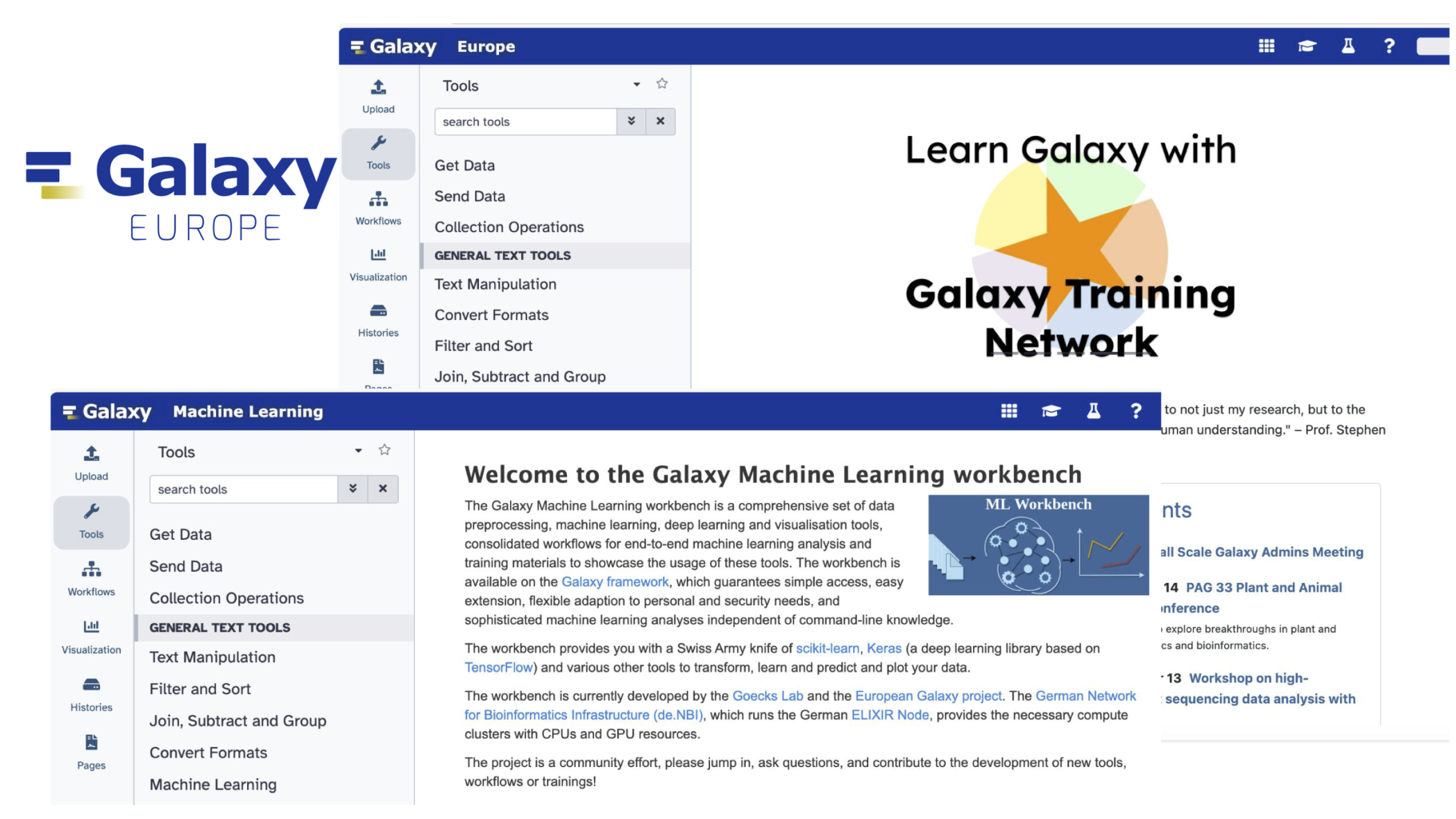 Source: https://usegalaxy.eu/
Since its recognition in December 2023 as an ELIXIR Recommended Interoperability Resource, Galaxy Europe has emerged as the largest Galaxy instance in Europe and one of the world’s leading platforms for open, web-based bioinformatics. Anchored by the Freiburg Galaxy Team, the platform brings together a wide network of contributors and collaborates closely with the U.S. Galaxy Project and numerous European partners to provide free access to thousands of scientifically validated tools and workflows. These resources support a broad spectrum of applications — one compelling example is machine learning. In response to its growing role in life sciences, the Galaxy Machine Learning Workbench offers a powerful suite of browser-based tools for data preprocessing, machine learning, deep learning, and visualisation. Built on the Galaxy platform, the workbench includes ready-to-use workflows and comprehensive training materials, enabling researchers to carry out end-to-end analyses without the need for coding skills. Developed by the Goecks Lab and the European Galaxy team, it integrates widely used tools such as scikit-learn and Keras (based on TensorFlow), creating a flexible environment for data exploration, modelling, and interpretation. The initiative is supported by the German Network for Bioinformatics Infrastructure (de.NBI), part of the ELIXIR consortium, which provides access to powerful CPU and GPU computing resources. Whether working with their own data or using public repositories, researchers can perform complex analyses, share workflows, and publish reproducible pipelines — advancing open, collaborative, and transparent science across borders.
The Galaxy Europe platform is anchored by the ELIXIR Galaxy Community, which has evolved from its origins as the ELIXIR Galaxy Working Group in 2015 into a central hub for collaboration, training, and innovation in data analysis. Today, the community serves not only as a coordinator of Galaxy’s adoption across ELIXIR, but as an inclusive, open forum where researchers, developers, and educators co-create tools and exchange expertise to advance reproducible science. It connects a vibrant constellation of national and regional Galaxy communities — spanning France, the United Kingdom, the Netherlands, the Czech Republic, and beyond — while actively supporting new groups across Europe and globally.
The community’s core aims include harmonising workflows, expanding training and infrastructure services, facilitating access to ELIXIR Core Data Resources, and embedding the FAIR (Findable, Accessible, Interoperable, and Reusable) data principles. It also supports thematic sub-groups such as Workflow4Metabolomics (W4M) and GalaxyP for proteogenomics. Within the broader ELIXIR ecosystem, the Galaxy Community plays a strategic role in sustaining infrastructure through shared governance, international partnerships, and continuous technical development. Its alignment with the European Open Science Cloud (EOSC) further positions Galaxy as a cornerstone of Europe’s open science landscape — not only in life sciences, but across the data-driven research spectrum.
Looking ahead, Latvian scientists are encouraged to take an active role in Galaxy Europe and its global community, with several upcoming events offering accessible ways to get involved. Biweekly Galaxy Community Calls provide an informal yet dynamic forum where developers, trainers, researchers, administrators, and outreach teams come together to share live demonstrations, discuss workflows, highlight regional initiatives, and offer community updates. These open sessions welcome new participants to listen, ask questions, or even propose their own presentations—offering Latvian researchers a valuable platform to showcase national initiatives, pilot training efforts, and build visibility within the broader Galaxy and ELIXIR networks.
Each autumn, European Galaxy Days convene in Freiburg, Germany, for a vibrant three-day gathering of users and developers. Organised by the Freiburg Galaxy Team, the event features strategic discussions, technical workshops, and a hands-on CoFest hackathon. Sessions blend platform updates and ELIXIR integration with Birds-of-a-Feather discussions on topics ranging from local server management to citizen science. Participants collaborate on developing new tools and workflows, advancing interoperability across the ecosystem. Open to all, including contributors from non-Member States, the event offers Latvian researchers an excellent opportunity to present their work, co-create solutions, and join a thriving European initiative.
Complementing these events is a comprehensive suite of training resources, including Training Infrastructure as a Service (TIaaS), which allows instructors to run Galaxy courses in secure, dedicated computing environments. Covering both introductory and advanced topics, these sessions help researchers gain practical skills in areas such as sequencing, single-cell analysis, and server administration. By engaging in these learning opportunities and community events, Latvian scientists join a global effort to advance open, reproducible, and collaborative science.
The Galaxy ecosystem offers a robust array of training opportunities, ranging from in-person workshops to its Training Infrastructure as a Service (TIaaS), which allows institutions to deliver Galaxy courses in secure, self-contained computing environments. These resources cater to both newcomers and experienced users, covering topics such as high-throughput sequencing, RNA-seq, metagenomics, single-cell analysis, and server administration, with a strong focus on skills that directly support everyday research. To further empower educators, Galaxy also provides browser-based training environments that make it easier to deliver courses and build long-term institutional capacity.
As previously reported, on 1 June 2025, Riga Stradiņš University (RSU) started the project RSU Participation in the Horizon Europe Programme, which will also implement one of the new ESFRI/ERIC Latvian National Partnership and Action Plans - the integration of Latvia into ELIXIR. Although Latvia is not yet a formal member of ELIXIR — the European life science data infrastructure—its research community is already well positioned to benefit from the Galaxy Europe platform and the broader ELIXIR Galaxy Community. Involvement in Galaxy-related activities would reinforce Latvia’s progress toward integrating with Europe’s research infrastructures and demonstrate the country’s growing readiness for full participation in the ELIXIR ecosystem.
On 1 June 2025, Rīga Stradiņš University (RSU) launched the project Participation of Rīga Stradiņš University in the Horizon Europe Programme (project No. 1.1.1.5/3/25/I/014), which includes implementation of one of Latvia’s new National Partnership and Action Plans under the European Strategy Forum on Research Infrastructures (ESFRI) and European Research Infrastructure Consortium (ERIC) framework – specifically, the country’s integration into ELIXIR. In this context, Latvia is also working towards obtaining ELIXIR Observer status.