
Madara Auzenbaha, RSU Researcher of the Year 2024: ‘Be like an explorer.’


Writer: Linda Rozenbaha, RSU Public Relations Unit
Assoc. Prof. Dr. med. Madara Auzenbaha experienced a moment of true satisfaction when the results of a pilot study that she is leading in collaboration with the Children’s Clinical University Hospital, ‘Newborn Screening for Spinal Muscular Atrophy’, resulted in this disease being included in the national newborn screening programme. To date, this has helped diagnose the disease in three newborn babies, enabling early intervention and providing critical treatment in a situation where every hour matters.
Assoc. Prof. Auzenbaha has been actively involved in expanding the newborn screening programme, and 15 additional diseases have been included in the programme since October 2024. However, upon learning about RSU’s decision to give her the Researcher of the Year Award, she was surprised.
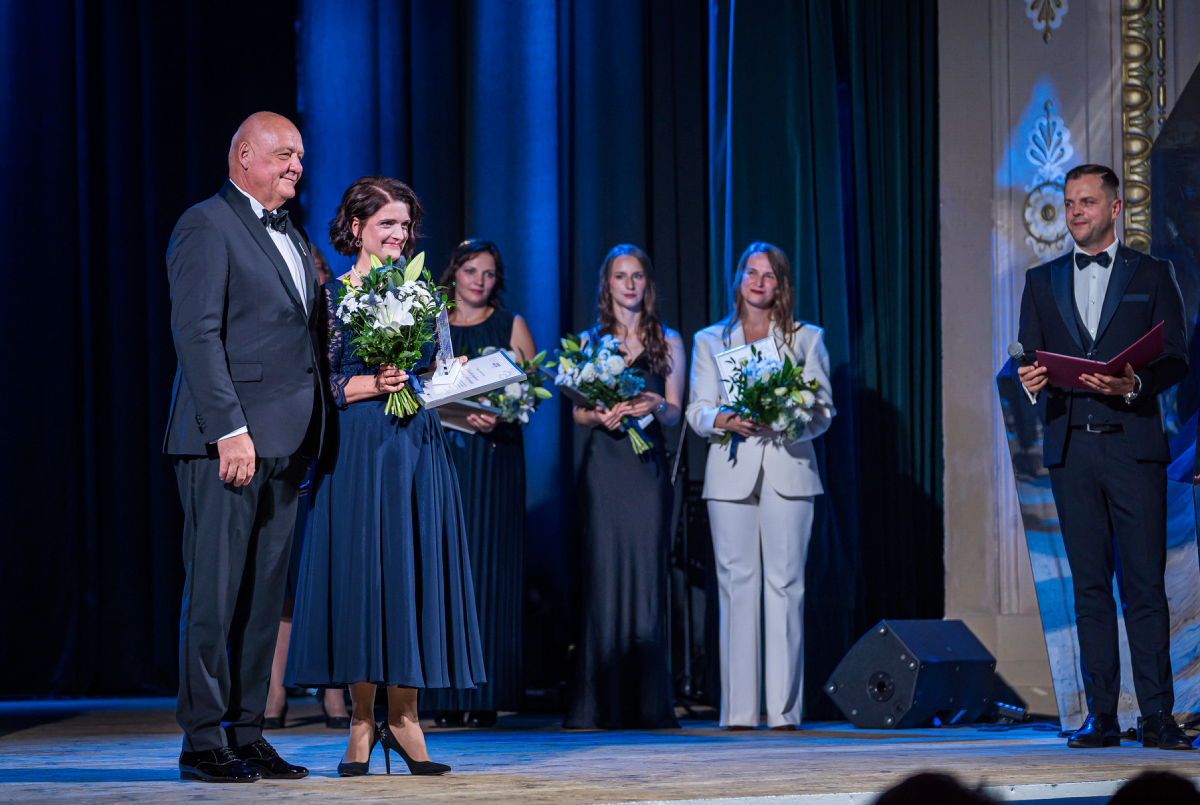
Assoc. Prof. Auzenbaha (second from the left) receiving the RSU Annual Award in 2024
After getting to know her work and interviewing her, I am convinced that alongside her meticulous research (Assoc. Prof. Auzenbaha has 31 publications listed in the Scopus database, of which she is either the first author or co-author), she genuinely cares about what happens to her patients. In this interview, she describes creating a home and a sense of belonging for patients and their families at the Rare Disease Coordination Centre at the Children’s Hospital as being something that brings her satisfaction. She also reveals that she does not look at the clock when she is working, saying:
‘I sometimes joke that I do not work, but that it is my life. I really love this job, and my enjoyment of it has not diminished over the years!’
Thanks to the pilot study you led, the disease was detected in three newborns, enabling doctors to start crucial treatment early. Gene therapy was even used in one of the cases.
Yes, it caused quite a stir in the media. Last year, on 4 September, gene therapy was used for the first time in Latvia. This was a unique situation.
To be honest, I never liked gene therapy classes either as a student or later as a university lecturer. I always felt it was funny to study something that would never happen. It felt like rocket science! That is why
it was a huge surprise for me to witness the moment that gene therapy was actually used in Latvia. Since then, my enthusiasm has only grown. In my view, it was truly a historic event – equivalent to the introduction of the railroad.
It has not been very long, but we have hopes that this child will do well. There is always a concern about the effectiveness of a treatment when it is implemented for the first time.
You are actively involved in research and also participated in RSU Research Week 2025 where you were the chair of the rare disease section and presented a report on the use of rare disease codes. How do we compare to the rest of Europe in the field of rare diseases?
In terms of registration, we look good compared to the rest of Europe. However, I would like to emphasise that the register shows how well we record data, instead of how well we recognise certain diseases. There might be a doctor with 500 rare disease patients, none of whom are included in this register. To a certain extent, this is an administrative issue, yet a very important one. It is no coincidence that our slogan is "To be counted, you have to be registered". It is a play on words that underlines how essential it is to know how many rare disease patients there are in the country. If we only register five patients, what kind of healthcare budget can we expect for patients with rare diseases? I felt it was important to address the medical community at the conference
because if you want your patient to be heard and taken into account, they must be registered.
I admit that I myself do not enjoy spending time and effort on patient registration, but it is meaningful and valuable work on their behalf.
You mentioned that the register is necessary in order to demonstrate how many patients need help. Does that mean that scientists nowadays need to have the skills to persuade politicians?
Yes, in fact, this is one of the most important tasks – to gain support and ensure that healthcare policymakers are able to allocate resources. This starts when they even recognise a particular problem as a priority. Sometimes politicians understand that this support is very necessary in the country, but we have so many needs at the same time! Given that I am the leading specialist in rare diseases in the country, I quite often have to speak with healthcare policymakers.
The diagnosis and treatment of rare diseases has the support and interest of policymakers; the only problem is the aforementioned limited funding. The same applies to research in general. A great deal of work, is devoted to fighting for additional or even basic funding.
How did you come to specialise in rare diseases alongside pediatrics?
I have never made my choices in the classic sense, by sitting down and weighing the pros and cons of treating children or adults, and which path would be “right.” Everything has happened naturally, organically.
I can say the same about choosing my profession and specialisation.
Our country is so small that there is not even a separate medical specialisation for rare diseases, so the path was not easy. I would like to thank the management, for example, Prof. Dace Gardovska, who always treated me with understanding, allowing me to choose more specific study cycles than other pediatricians to move toward the rare disease field, as well as medical doctor Ieva Puķīte, whom I have always regarded as a model physician. I am also very grateful to the management of the Children’s Hospital and the Ministry of Health for establishing a structure for rare disease patients. I greatly appreciate that they understood that rare disease patients also need their own doctor, especially those who do not have one. For example, if someone has a rare disease that affects only the lungs, the patient visits a pulmonologist and follows their recommendations. But there are a number of patients whose diseases cannot be treated within the scope of a single medical specialisation because their symptoms affect multiple body systems, and they have to see many different specialists, making it sometimes difficult to navigate through all the conclusions and visits. My greatest satisfaction is the opportunity to create a home for these patients – a place where they can come, receive advice, and find a specialist they can trust.
This fulfilling everyday life you describe takes place between clinical and research work, as well as working with students.
I admit that it is quite difficult to balance my work between the hospital and the university. Sometimes it feels like there aren't enough hours in the day [smiles], because I also supervise young researchers’ doctoral theses. Given my current position, there is also quite a lot of administrative work seeing as I have to develop visions and plans for improving the treatment of rare diseases. We cannot stop, and we are currently implementing several European projects to maintain our European level! Of course research, patients, university work, and doctoral students all require time.
How do you feel about being part of the RSU community?
I graduated from RSU myself, and since then I have been closely connected to it. My mother also worked at RSU as a research secretary her entire life. I hope that my children will also study and work here.
I have the highest praise for RSU; I cannot imagine myself anywhere else. I have also been very fortunate to work with excellent colleagues – both in the laboratory and at the department where the environment is very supportive. Prof. Juta Kroiča, Head of the Department of Biology and Microbiology, and Linda Gailīte, Manager of Scientific Laboratory of Molecular Genetics, have always supported all of my ideas.
Do you see any doctoral students who could potentially become your colleagues at the Rare Disease Coordination Centre?
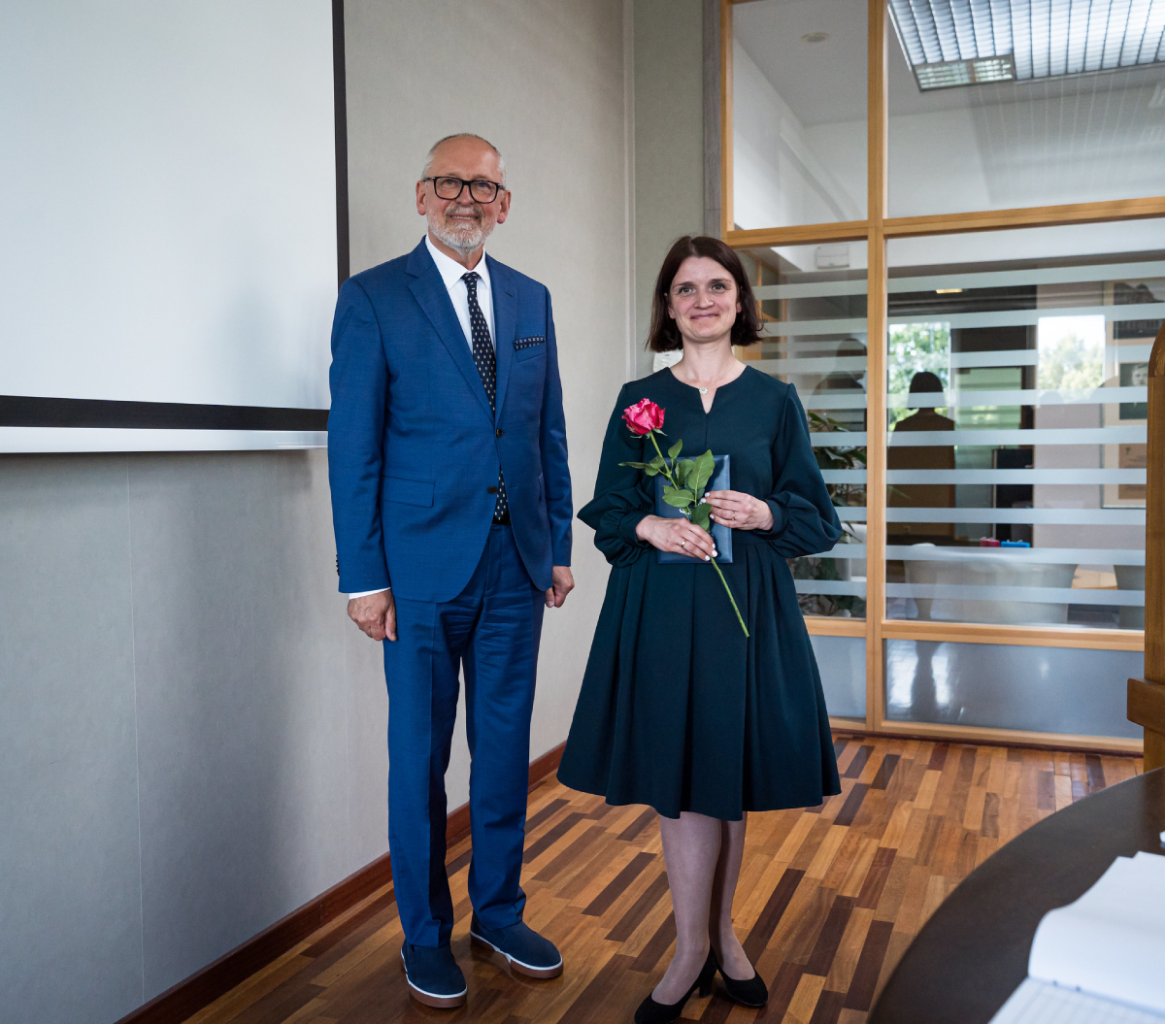 On 20 June 2024, receiving an associate professor diploma from RSU Rector Aigars Pētersons
My current doctoral students are already outstanding specialists in their fields, so it is unlikely that they will join my clinic. It should be noted that this work has its own unique features – our patients stay with us for life, and we become very close to them. Some doctors see this as an advantage, others as a burden. There are those who prefer to meet a patient on Monday and by Wednesday have already forgotten their name.
In this job, if I first meet a patient as an infant, I continue to treat them until they are 18 years old, which means I usually also know their mother, father, godmother, godfather, brothers and sisters.
Of course, I am always pleased when a young doctor shows interest in this job, because the field of rare diseases is currently one of the fastest-growing areas in medicine. We started with a few hundred rare disease patients, but now there are more than 21,000 registered in Latvia. I am convinced that within five years there will be job opportunities and new colleagues will be needed.
Perhaps this is a stereotype, but young doctors must come to terms with the reality that children with genetic diseases diagnosed in childhood are, in most cases, not curable. Patients and their families often find themselves in very difficult situations where, as you said, they are in constant contact with a doctor…
Doctors draw on their life experience in their work. When I was young, I once rather thoughtlessly told a mother of one of my patients ‘Yes, this must be very hard for you…’ This is not something I would say now. The mother looked at me and replied: ‘Yes, doctor, but if I were not here for Kate, who else would she have?’ Now I feel the same sense of responsibility:
who else will take care of this little person, my patient? The fact that someone has fewer possibilities does not mean they have lesser needs.
No matter how ill a child is, their family loves them deeply and cares for them with great dedication. Very often, what they need most is simply support – and it is only fair that they receive it.
From your experience, what would you recommend to those of us who may not come into contact with someone diagnosed with a rare disease? What should we know about your patients and their families, and what perceptions or behaviours should we reconsider?
Actually, we know a lot. We are currently trying to be more understanding and open. However, there are still many things we only do in a formal sense. For example, an entrepreneur might open a café and consider access for people with mobility impairments.
On paper, everything is in place – doors have been installed, and a ramp has been built so that people in wheelchairs can enter. But in reality, the door opens outwards, the ramp is too steep, and no one could possibly hold the door, manage a wheelchair, and help the person inside at the same time.
So, we appear inclusive on paper, but in practice we have not really thought through how a person will be able to use the facility.
I believe that many of our efforts to be inclusive only appear to be inclusive – we do not always think everything through.
It is also important to foster greater acceptance in educational institutions. Children can be very harsh, especially towards those who are different, maybe not as clever, not as attractive, not as athletic…
There is still much room for growth in terms of acceptance, although things are far better than they used to be. In the past, if a family had a child with a disability, that child was often hidden away, and even relatives sometimes did not know they existed. Today, such children are no longer excluded from society – they are visible in public places, and, for example, not every screaming child on public transport is immediately considered ill-mannered or spoiled. Public tolerance is improving, and I believe we are moving towards greater understanding and acceptance.
I would also like to see more assistants, and for them to be better paid. As doctors, we want to do everything we can. Our patients’ lives are harder than most, but the greatest challenges often come when they turn 18 and leave school.
Are you, in a way, not only a doctor, but also a psychologist for parents…?
…and aunts, other relatives as well.
Your consultations must take longer, then.
Yes, our consultations are long – we devote an hour to each patient. I am very grateful to the Ministry of Health for recognising this need.
If everything had to be done within a 20-minute consultation, the system we have built over many years, with great care, would simply collapse.
This year, both the Rare Diseases Forum and the Conference on Rare Diseases have taken place. What would you like to highlight from them?
I am very pleased that the Forum brings together healthcare specialists, patients, and everyone who cares about rare diseases. I believe it is a great format and we should definitely continue the same way.
Of course, despite positive developments, access to specialists remains limited. Unfortunately, I believe that during my lifetime, the needs of all rare disease patients will not be fully met. It should be noted that the treatment and care of patients with rare diseases is the most expensive everywhere – both in a literal and figurative sense, as it represents an economic burden.
At conferences, especially international ones, you have the chance to meet fellow specialists from abroad. Considering how some diseases are extremely rare, do you have many international peers?
We cooperate quite well internationally, but at the same time, we are managing very well on our own at the moment.
The most challenging cases are those where there is a shortage of specialists. For example, there may be a patient with an extremely rare disease, perhaps one of only 30 to 40 known cases worldwide, so there is really no one to provide advice on treatment and care. This is the biggest problem in the field of rare diseases: often, there are simply no guidelines for these ultra-rare conditions.
At the same time, it is fascinating!
I always tell my students: ‘I have a wonderful profession because I am like Christopher Columbus, the explorer; I can always discover America.’ But on the other hand, it is also terrible not to be able to tell patients and their parents what will happen and how. Especially with ultra-rare diseases – if there are only three or four registered patients in the world, how can a specialist who has treated just one of them possibly help me? They can’t.
Is it not the case that, when searching for a rare diagnosis, patients come to you only after seeing countless other doctors?
Most patients who come to me already have a diagnosis, usually made by a geneticist. Even after conducting all possible tests, their office may still be unable to determine the diagnosis. There is often a sense that there must be a genetic cause, but it cannot be identified. In fact, genetic diseases are somewhat easier to diagnose than other types of rare diseases, because the gene can usually be found. But if we do not understand where the symptoms originate – whether from an infection, a rare type of cancer, or an autoimmune or inflammatory condition – it can be much harder to find the answer.
It is particularly difficult in adulthood. For example, a patient may have a thyroid problem, be short in stature, suffer from headaches, sleep problems, and joint pain. Which of these symptoms are connected and indicative of a single diagnosis, and which are separate? After all, anyone can have headaches, sleep issues, or thyroid problems. Are all the symptoms related to one rare disease, or are only two of them connected, while the rest are simply because the patient is middle-aged? It is not easy to disentangle the symptoms and understand whether someone has a rare disease, or what it might be.
Is artificial intelligence (AI) somewhat helpful here?
Yes, we use specialised AI programmes that assist in finding a diagnosis, but AI must be provided with detailed patient information. We still have to ask the AI programme whether a particular symptom is essential or may not even be present. There are also programmes for rare diseases that include libraries of specific facial features, helping to identify these features. However,
these AI programmes are not advanced enough for doctors to be able to retire just yet.
You compared gene therapy to the introduction of the railroad. What can we expect in ten years in the field of rare disease treatment? Will there be a revolution?
It is hard to say, but I think we can expect a steady increase in the number of diseases that are treatable with gene therapy. There will be more options for treatment, and various studies are already exploring possibilities such as preventing certain types of cancer. Of course, development and funding still depend heavily on the global political situation. The more strained the situation, the less hope there is for increased investment in medicine and science. We are already experiencing this in our small country: the more money goes to defence, the less is available for patients. On top of that, patients still have to share the available funds among themselves.
What are your current personal challenges in research?
When we worked on a pilot project to introduce newborn screening for spinal muscular atrophy in Latvia, we used known and well-studied substances in our research. Right now, I have a new research idea, and I do not yet know how it will turn out. It is related to a hereditary disease, familial hypercholesterolemia. This time, we want to search for a metabolic product that could help identify the disease. I am really excited about this research idea!
Nominate candidates for the RSU Annual Awards by 5 September
Related news
 Tenured Professor Baiba Vilne: bridging biomedicine, mathematics, statistics and computer science Researchers Up Close


