RSU Resident of the Year 2024: family doctor Daina Malinsa on caring for patients through every stage of life


Writer: Linda Rozenbaha, RSU Public Relations Unit
Photos: Courtesy of RSU and Daina Malinsa
We continue to highlight the winners of the Rīga Stradiņš University (RSU) Annual Awards. Daina Malinsa, Resident of the Year 2024, is not only a resident in family medicine, but also our colleague – she is a simulation instructor at the Medical Education Technology Centre (METC). She is very familiar with this work environment. Daina calls it ‘miciņš’ [from the Latvian abbreviation for METC – Ed.note] with a smile and has returned to the Centre after a break. She previously worked at the METC in a different role when the Centre was first established.
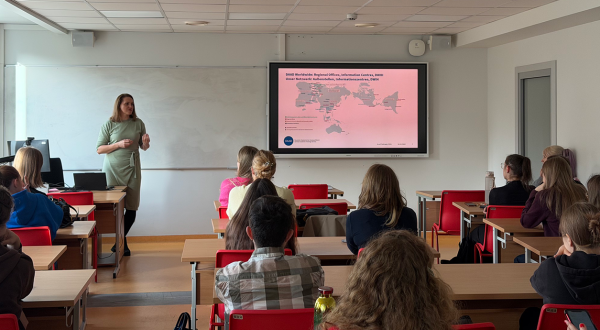
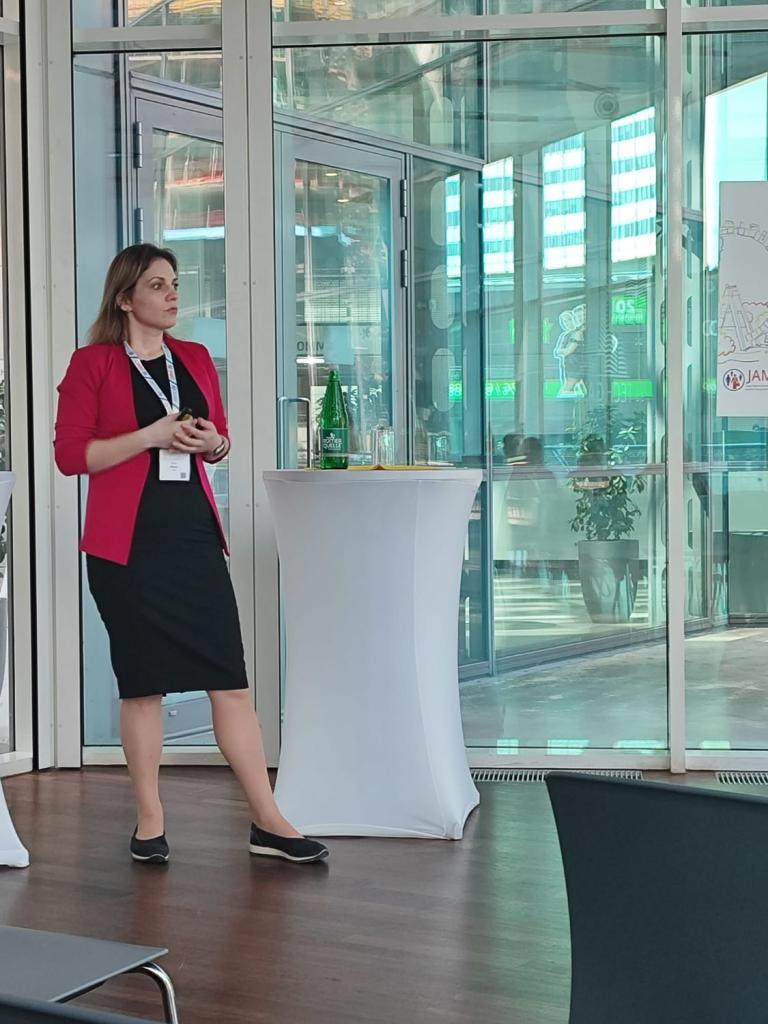 Daina at the European Young Family Doctor's Movement conference in Vienna
Daina Malinsa completed her undergraduate studies in medicine in 2015. Her professional career started in emergency medicine, but currently she is a resident family doctor in Ragana alongside her work at the METC. In addition, Daina has a large family – she and her husband have four children, which is why she has taken several breaks from her studies. She is now in her third year of residency.
I understand that family medicine was not your first choice for residency.
After completing a difficult sixth year of studies, I wanted to take a break and went to Germany. It was an opportunity to think about what to do next.
While I was sorting out the paperwork to be able to work there as a doctor, I was a doctor’s assistant in a surgery department in Germany and also worked a little in intensive care.
It was a very valuable experience, as I saw how healthcare works in this country.
I met my future husband in Germany. This was followed by parental leave, then the pandemic began, and my family and I decided to return to Latvia. That is when I entered family medicine residency.
What was the plan before that?
I had been thinking about traumatology for a long time. But in my sixth year of studies, I began to wonder whether this would be a specialisation that I would feel comfortable with in the long term. Family medicine seemed to fit well with family life, as there are no night shifts – it is important for me to be at home when all the little ones go to bed and want to see me. Another reason is that I love the diversity of medicine, and this specialisation is very multifaceted.
I am drawn to the special beauty of family medicine – the opportunity to see a patient from a young age and then be with them through every stage of their life. I very much hope that in the future I will have my own practice, and I will also develop such relationships – like my teachers who have known their patients since they were babies. They see children grow up, go to university, and years later bring their children to the doctor. I think this is something very special and touching.
Of course, being a family doctor also means that people recognise you on the street. Maybe at some point it can become a nuisance to be asked for advice everywhere you go – I have heard this from colleagues, they are tired of it. But for now, I am inexperienced enough that it does not bother me.
In Ragana, where I work, I do not feel it so much because I do not live there, but I experience it in my place of residence, Garkalne. Neighbours, parents at the nursery and, of course, the wider family circle and friends ask for advice. I often get questions on weekends. That is not a bad thing – I understand that access to doctors in Latvia can be difficult and people just need help. I would not want to spend hours sitting in a hospital reception on my day off just to have tests done and decide on the most appropriate treatment. There have been all kinds of situations, I have been asked to bandage a finger – not all family doctors do that. I help when I can, my heart goes out to people. There are times when I have to refuse, because I do not always have the opportunity to help.
How is your work as a resident in family medicine in Ragana going?
I see patients in the practice and, as a resident, my work is supervised by a doctor. I am about to start my third year of studies, and then I will have more independence. There are patients who only want to see their own doctor, which is understandable, but most have no objection to a resident. By the way, as a patient, I am happy to see resident doctors.
With a resident, the patient will get a "double check-up" – both the new doctor’s and the experienced specialist’s point of view. And sometimes, perhaps, the perspective of a resident – a specialist who has just acquired the most up-to-date knowledge – will be the most relevant, will it not?
Yes, the patient actually gets the opinion of two doctors. I would like to highlight that the culture of healthcare has changed significantly, and the attitude of young doctors reflects a more European approach.
As a patient, I feel that with the young doctors I have the opportunity to be more actively involved in decisions about my recovery.
The legacy of the Soviet era, where ‘the doctor said so, and that is how it will be’, is no longer felt. This change in attitude is pleasant. I think that the young doctors devote more time to talking with patients, and it is nice to see how these changes are being implemented in everyday practice.
There are organisational constraints on how much time can be devoted to this – how long a visit can be, at least at a public institution…
That is true. No one likes to wait, and appointments with medical specialists are limited to 30 minutes, while family doctor visits are restricted to just 15 minutes. That is simply not enough time for a family doctor, so we often schedule longer appointments. Of course, knowing your patients helps you plan your time more effectively – you get a sense of who will need more time, who just needs a document signed, and who books an appointment just for themselves but ends up bringing the whole family.
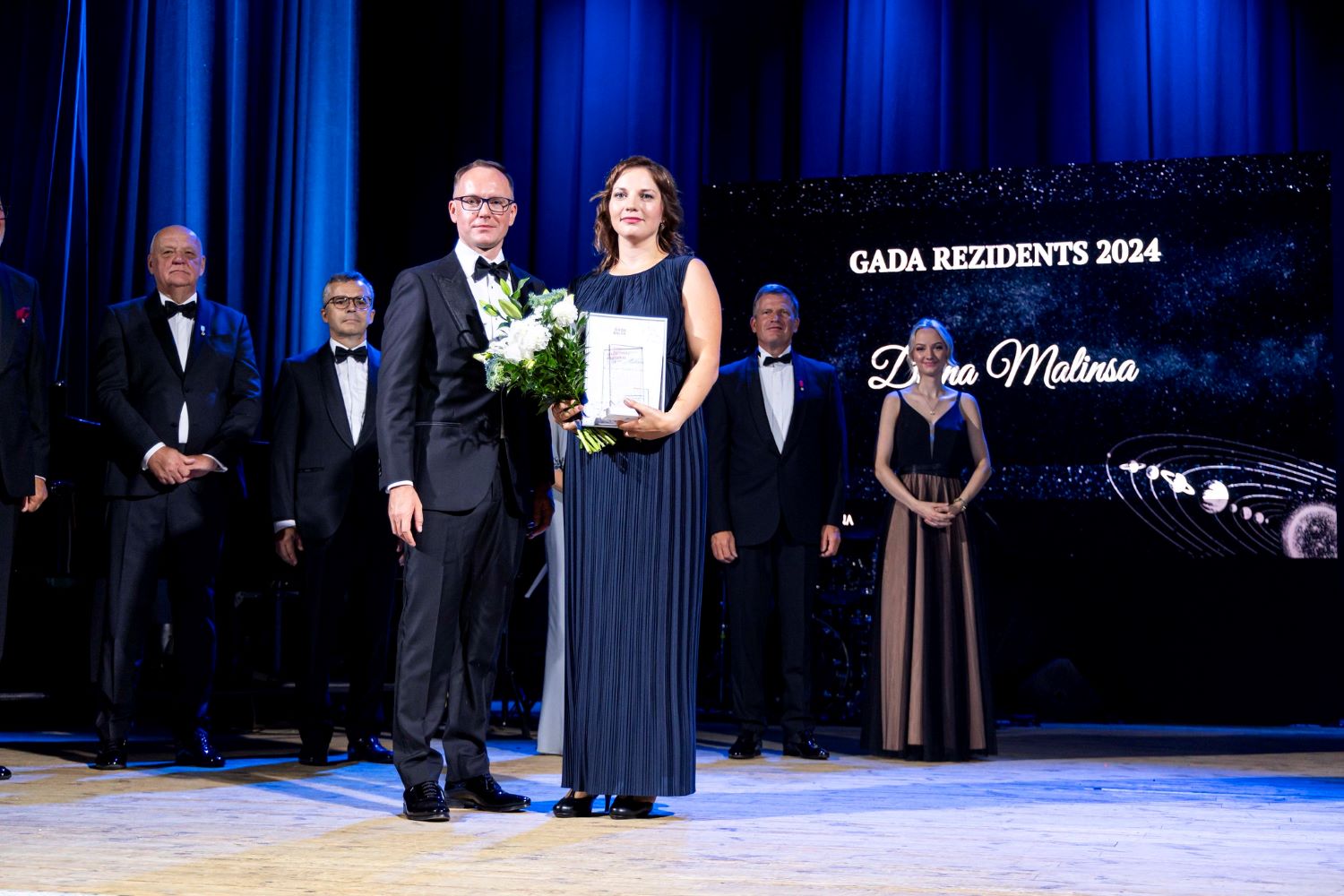 RSU Academic Ball in 2024. Assoc. Prof. Andris Skride, Vice-Rector for Health Studies, and Daina Malinsa, Resident of the Year
Please share some stories from your doctor’s practice that have particularly stuck in your memory – both heartwarming and challenging ones!
On several occasions, I have shared specific patient examples with students, and they have listened with surprise in their eyes. For example, when they find out that a family doctor’s practice has an ECG machine. But it is true – and it highlights just how different experiences can be, especially when comparing how well-equipped practices are in Riga versus those in the regions.
The work of a family doctor is very diverse. You need to know about everything from heart disease to mental health. Patients come with referrals from specialists, which sometimes contain almost no information. The patient has paid the money, seen a specialist, maybe had some tests done, and then received an answer: go see your family doctor. And so, we become the ones who have to explain other doctors’ decisions and thought processes – even though we do not always have all the information available to us.
To be honest, even we – family doctors – cannot know everything about every field and every diagnosis. But it is often expected of us. And what worries me most lately is indifference. You can sense it from different directions – from the system as a whole, from other doctors, and unfortunately also from some patients. There is a feeling that family doctors are given a lot of responsibility, but our voices are rarely truly heard.
Patients themselves are often indifferent about their treatment. I can compare it with the situation in Germany. For example, when I took blood samples, the patient asked what each test tube was for, they asked for every detail, they wanted to know everything about the prescribed medications.
Most of the patients there follow the recommendations very closely. In Latvia, I am happy when someone follows the recommendations, but many people have the attitude that they will eat as they always have, regardless of their diabetes, and will continue to drink and smoke as before.
There have been times when I realise that if I do not help this patient, no one else will. For example, one woman had very serious health problems, she was unable to work and was no longer mentally stable due to her illness. I tried to support her in every way I could – I helped her arrange examinations, I wrote on a piece of paper where she needed to go and which public transport to take – step by step. I referred her to specialists, wrote all the necessary documents for her to get a disability status – otherwise she would not receive any money to live on. And in the end, I only got one sentence in the specialist’s extract, with nothing specific. Even though I had made it clear why a detailed opinion was needed. And then I did not hesitate to call the specialist and ask – was it really impossible to write more, given the situation? The answer was: but she was fine, the woman said she felt well. Maybe she felt well that day and did not want to admit her problems. Of course, I am happy to have excellent specialists with whom the cooperation is genuine and supportive.
When it comes to the positive aspects of my job, I enjoy caring for newborns the most. They change so much every month, they grow up so fast. I had a break from work during which I had not seen my little patients for a while, and I was shocked at how quickly the babies had grown! I really like that about my job!
I am happy for every patient who listens to me, follows my advice, and solves their health problems – that gives me great satisfaction.
I like to see the result of my work. This is not possible in all medical specialties – when I worked at a hospital in Germany, I did not see patients more than once, though I was very interested in what happened to them afterwards.
Would you say that outside Riga, where doctors are not as readily available, family doctors have a greater responsibility?
Everyone has their own difficulties, and Riga also has its own particularities. In Latvia, people often lack the means to pay for healthcare, and access to specialists is limited. Similarly, in rural areas, you cannot get everything at once. However, if there is a regional hospital nearby, it is a little easier – you can call, arrange a visit for the patient, etc. There are specialists who come to the countryside every three months or once a month and the waiting list is very long... But I agree that a family doctor in a rural area has to take on much, much more responsibility, because often there will not be a colleague around to help, except for emergency medical assistance. And then you have to hope that they will take the patient to a hospital where they will really help. And there are other peculiarities...
What do you mean?
There are lonely people who have no one to help them, or financial resources – it is clear that they will not be able to afford all medications.
Then there is the peculiarity of rural areas – women who work in the garden are unlikely to go to a physiotherapist because of back pain. And the peculiarity of spring in the countryside – people work themselves to exhaustion in the garden, which leads to high blood pressure, back pain...
I also make home visits. For example, I visit newborns because, especially in the cold winter months, it can be difficult for families without a car to travel by public transport — and sometimes they live quite far away.
Where do you see yourself after completing your residency?
I would love to work outside Riga – I do not want to work in the capital, the exception being trips to visit students at ‘miciņš’. I live in Garkalne. My children go to nursery and school here, and I hope to find a placement opportunity in this region. I will not go to, say, Krāslava, because I cannot move my whole family there. We have settled here. I have heard of fellow female students being offered a place in a small town, but what will they do there? They say – I do not have a husband yet, I do not have a family, I do not want to be there alone. Schools and hospitals are closing in the regions – that is a real problem. Quite a few stars need to align for a young specialist to truly want to live and work in a rural area. And money will not always solve it.
In Riga, I like working at the METC. I work with family medicine residents, developing a simulation cycle. Initially, it was a week-long cycle, but now there are simulations for the first and second years of residency. We researched and looked at what is included in the programme and what is missing, because the family medicine residency is too short. There is so much students need to know and be able to do – it is hard to fit it all into three years. I surveyed my colleagues to ask them to evaluate what was missing from the residency and what would be valuable to learn in the simulation, and I included that as well.
For example, we have a whole day where we talk about patients’ rights from both the patient’s and the family doctor’s point of view. You learn the theory behind these issues during your studies, but it is a different matter when you face them in real life. And, using simulation, we play it out in a real-life situation.
Do students talk to real people in the simulation exercises?
Yes! For example, a simulated patient asks for information about another patient. The doctor must recognise that such information cannot disclosed, but... some patients can be very cunning and ask questions like this. We also simulate scenarios involving emotionally aggressive patients – for instance, someone shouting – and practice how to de-escalate the situation and respond appropriately.
We have simulated actors, simulated patients.
So, they are real people, not video simulations?
Yes, they are real people! Sometimes they are colleagues from the centre, other times people who have applied for a special simulation participant programme. There is a worldwide organisation of simulated patients. These ‘patients’ are specially trained. It is specified how to behave in a specific simulation, what to do, what to say, thus creating an impression of reality. These simulations are not easy! But they are very interesting. We then analyse the situation together with the residents; it is a dynamic process.
What does your experience as a student working with medical residents give you?
I still remember how I felt as a student, and I try not to introduce anything that caused me negative feelings. I have to say that students like practical classes, especially those who experienced the pandemic, because they did not have as many opportunities for face-to-face practical work.
You have four children. How do you manage to balance work and home life?
My husband and I planned a big family, and we have achieved that goal. Of course, it is not easy, but I have a supportive husband and a mum who ‘save’ me. My friends always ask me how I manage it all and where I get my energy from. I do not know (smiles).
I live by the motto: the more I do, the more I get done.
There are days when I just need some peace and quiet, or simply to switch off by watching a bit of television. After that, I feel recharged and ready to keep going.
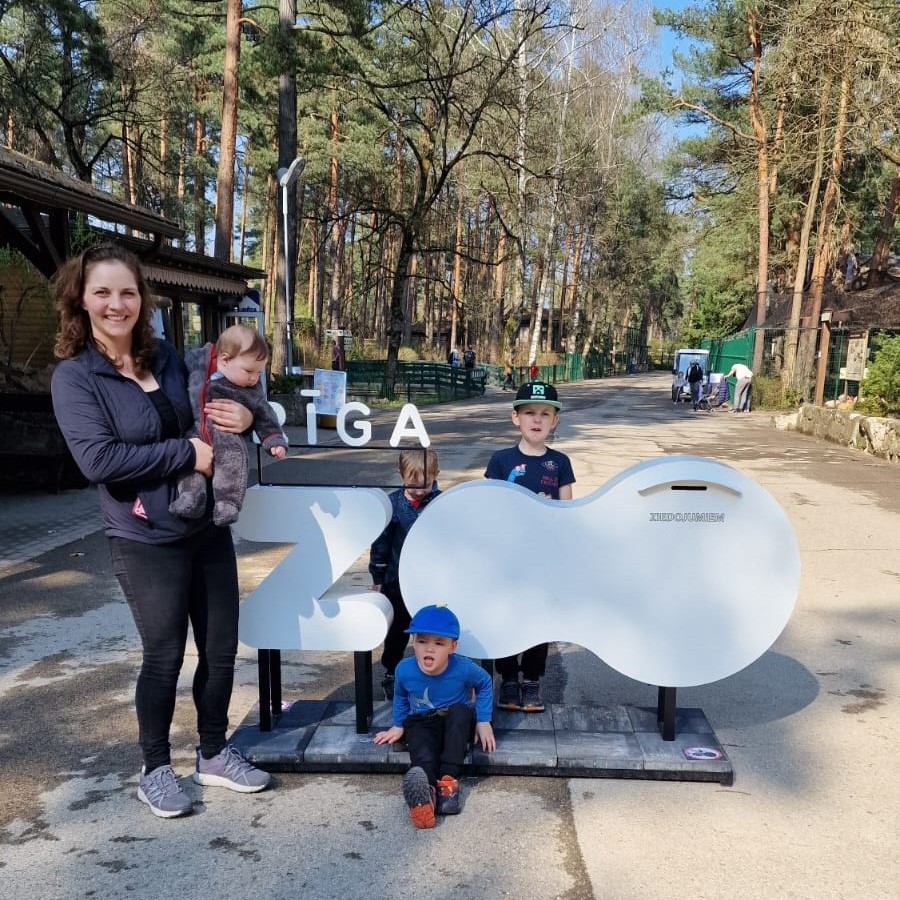 Daina with her children
I have many hobbies, but I always try to focus on what the priorities are at the moment. I enjoy my work, because I really like it. In the evenings, of course, I have an internal struggle, when I have to put children to bed, but I would really love to have a proper conversation... with adults. But I am glad that, for example, my child who is about to start school is already curious about medicine – at a level appropriate for his age. For example, he wanted to understand what magnetic resonance is. And we spent the entire evening discussing that there is a machine that you go into and what it does. Later, I found pictures of brain anatomy and explained it to him. I was genuinely happy to share my profession, and he listened with real interest.
Related news
 RSU students explore study and research opportunities in GermanyFor RSU Employees, Research, For Students