International ESRS Summer School at RSU: focus on the future of rural areas in the digital age


From 6 to 10 July, the Rīga Stradiņš University (RSU) Faculty of Social Sciences will host the European Society for Rural Sociology (ESRS) Summer School, organised by the Healthy and Sustainable Food Systems Research Group. The event will bring together 28 doctoral students, master’s-level researchers and experienced experts from various countries around the world to conduct an in-depth analysis of changes in rural areas in the digital age.
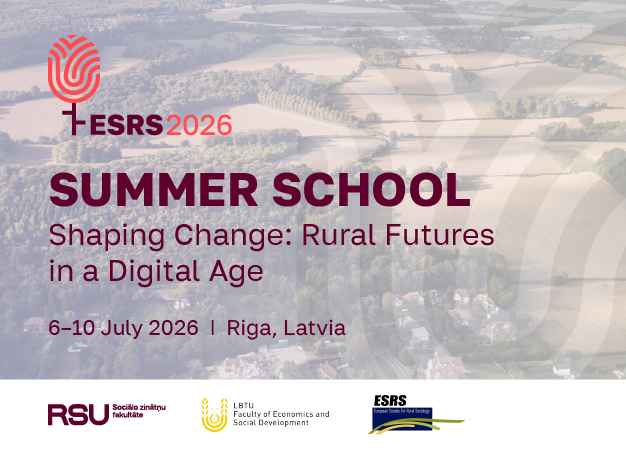
Participants represent a wide range of countries, including Japan, the United Arab Emirates, India, South Africa, Germany, the United Kingdom, and Latvia. The summer school at RSU takes place in an international and interdisciplinary environment, bringing together perspectives from the social sciences with practical approaches to addressing policy challenges.
Digital transformation and the future of rural areas
The summer school focuses on the development of rural areas during the digital transformation. The programme explores how technology, innovation and the use of data are changing life outside major cities, and what social and economic consequences these changes have for local communities.
Special attention will be paid to topics such as how digitalisation can help improve access to social services in rural areas and promote more efficient use of resources where they are limited; how the digitalisation of agriculture and forestry affects rural development as a whole; and how to ensure that the opportunities created by digital transformation are equally available across all rural regions, regardless of their geographical location, topographical characteristics, or socioeconomic conditions. Discussion of these issues will help foster a better systemic understanding of the interplay between digitalisation and balanced rural development.
From academia to practice
The summer school combines academic lectures with practical activities and the exchange of experience. Over the course of five days, under the guidance of six international experts, participants will take part in lectures and workshops exploring how to study rural digitalisation, analyse the new methods and data enabled by digital technologies in rural research, and examine the changes in theories and analytical assumptions needed to understand the impact of digital transformation on rural areas.
Participants will also learn about Latvia’s experience, including through visits to the laboratories of Latvia University of Life Sciences and Technologies (LBTU) and local companies working on innovation and regional development. The programme will also feature informal activities, including community storytelling evenings, where local residents will share their experiences of life and change in rural Latvia.
Public panel discussion on 6 July
On 6 July, as part of the summer school, a public panel discussion open to the wider public will take place. International experts, representatives of Latvian local governments and researchers will discuss issues related to the future of rural areas in the digital age.
The panel discussion will focus on whether, and how, digital technologies can help address the challenges of rural depopulation, as well as the role of innovation and public engagement in sustainable regional development.
International cooperation and scientific impact
The ESRS Summer School at the RSU Faculty of Social Sciences is organised in collaboration with the European Society for Rural Sociology, the Social Sciences Research Centre and Latvia University of Life Sciences and Technologies. The event builds on the discussions initiated at last year’s 30th European Society for Rural Sociology Congress, organised by RSU, and promotes the development of new research collaborations. Prof. Dr. soc. Miķelis Grīviņš notes: ‘Holding a summer school of this kind in Riga not only brings together leading international experts to discuss issues relevant to Latvia, but also once again highlights Riga and RSU as a centre for research of European significance.’
Following the conclusion of the summer school, the organisers plan to prepare a special issue of an international Q1-ranked scientific journal dedicated to rural digitalisation and social change.
About the event
Although the academic programme of the ESRS Summer School is intended for registered participants, the summer school will also include a public event on 6 July, open to students, researchers, local government representatives, entrepreneurs and anyone interested in rural development and digital transformation.
If you have any questions, please contact the summer school organisers Jānis Šabanovs or Miķelis Grīviņš.
Related news
 RSU Medical Law Conference highlights patient safety and responsibility in healthcare Conferences, workshops, Law