Anthropological study on Latvia’s population continues this year


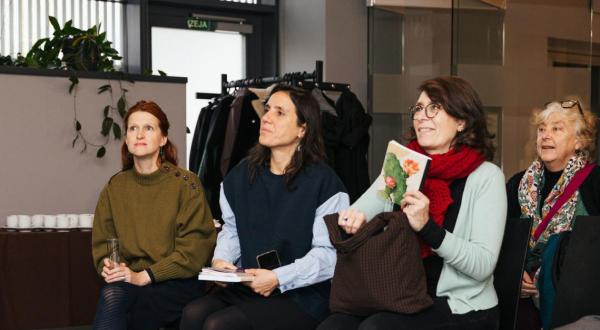
On 15 January, Rīga Stradiņš University (RSU) held an event to express gratitude to those students and researchers who actively participated in the Jēkabs Prīmanis’ Anthropological Study on Latvia’s Population led by RSU Prof. Jānis Vētra. This year, the study is planned to continue in Bauska, Valmiera, Saulkrasti, and other locations in Zemgale and Vidzeme.
Since 2024, the project has been implemented by a team of researchers and students from the RSU Institute of Anatomy and Anthropology. The aim of the project is to systematically study the anthropological and health characteristics of Latvia’s population, based on both the historical legacy of Prof. Prīmanis and modern scientific methods. Researchers from RSU, together with students, are continuing the study that was initiated nearly 90 years ago by the then renowned anthropologist Prof. Jēkabs Prīmanis.
Addressing the participants of the event, RSU Rector Prof. Aigars Pētersons emphasised the significance of the project and its development over the course of two years:
‘Today, we express our gratitude to the people who, through their work, time, and dedication, are shaping one of the most important contemporary anthropological and health studies in Latvia. The Jēkabs Prīmanis project is unique in that it brings science and society together, and its results are made possible by people’s trust and the professionalism of researchers.’
The Rector noted that the data obtained and the conclusions drawn will allow the project’s results to be presented at high-level international scientific congresses and conferences in the near future.
RSU Vice-Rector for Science Agrita Kiopa, in turn, highlighted the wide public involvement in the project: so far, 2,055 participants have taken part in the study. She noted that the high response rate is most likely linked to people’s desire for a sense of belonging to their place of origin and their wish to make a lasting contribution to science by taking part in this Latvia-wide study.
The project has collected extensive data across various regions of Latvia. In 2024, 690 participants took part in the study in Piebalga, while last year in Kurzeme, there were 423 participants in Kuldīga, 563 in Liepāja, and 379 in Ventspils. During this stage, 27 RSU students from the Medicine, Pharmacy, Nursing, Midwifery, and Psychology study programmes were actively involved in the project. It is particularly encouraging that five students from the Latvian Academy of Culture (LAC) also took part in the project’s second year, thereby expanding interinstitutional cooperation. The LAC students come from the cultural sociology and management study programmes. Over the course of the project, they gained unique experience in human structure, anatomy, and physiological measurements.
Project manager Prof. Vētra thanked the students for their endurance and professionalism and emphasised that working on the project had not been easy, either physically or emotionally. For example, in Liepāja, 160 participants were surveyed within nine hours in a single day, and another 90 within five hours next day. Such intensity required a high level of discipline, concentration, and teamwork.
At the same time, Prof. Vētra outlined the next steps of the project. In the summer of 2026, over a period of four weeks, a team of researchers and students will go on expeditions to Zemgale and Vidzeme, including Bauska, central Zemgale, Valmiera, and the Vidzeme coast, starting with Saulkrasti. These field trips will both enrich the study results and provide students with valuable practical experience. In addition, one of the main tasks of this year is to achieve a complete transition to electronic data entry, abandoning the paper format in order to speed up the processing of large volumes of data.
Related news
 RSU hosts CNRS/EHESS Centre for Russian, Caucasian, East European and Central Asian StudiesResearch, International Cooperation