
'Our strength lies in humanity and critical thinking': interview with RSU Researcher of the Year 2025 Ieva Puzo


Writer: Linda Rozenbaha (Public Relations Unit)
Photo: Courtesy of RSU
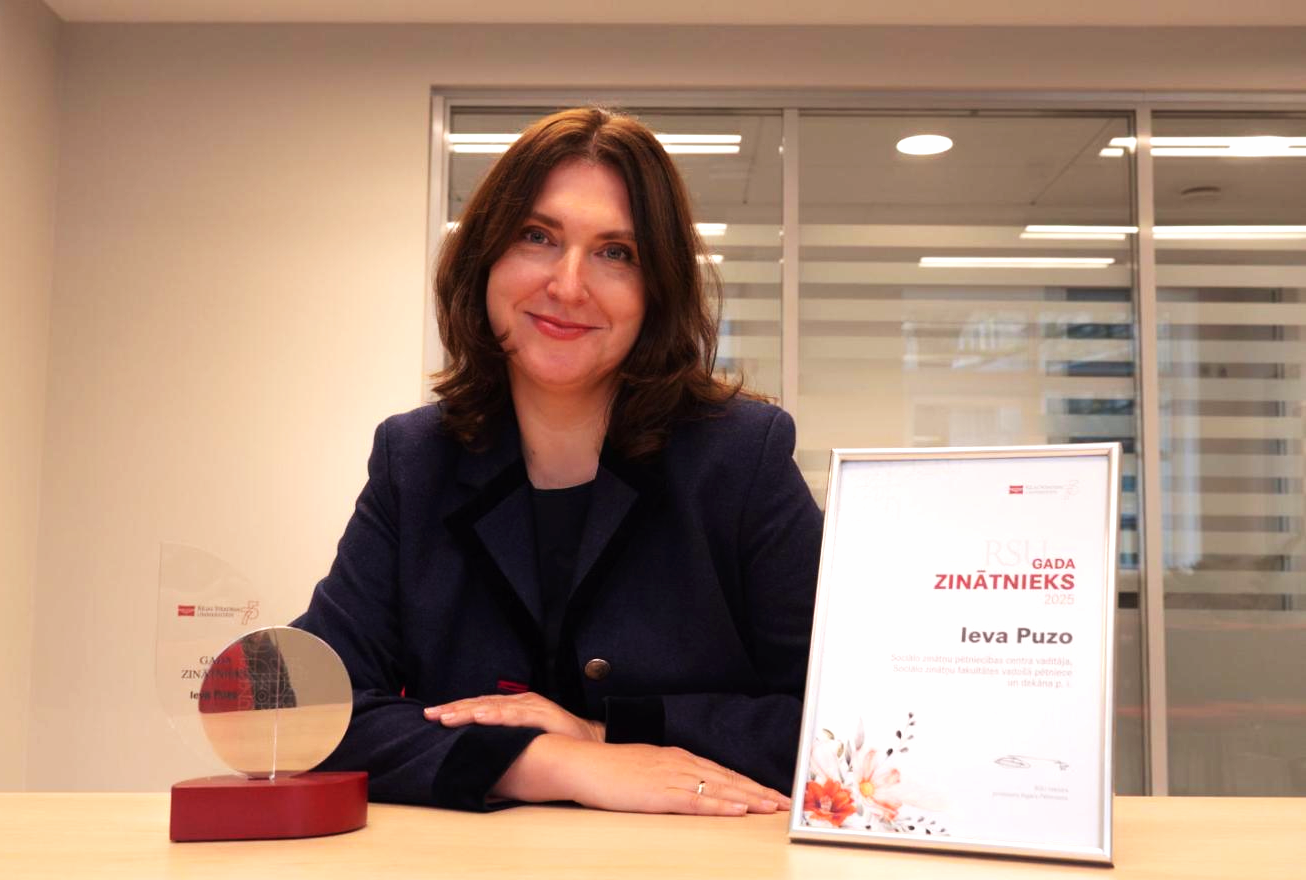
We continue to introduce the recipients of the Rīga Stradiņš University (RSU) Annual Awards 2025. The award for Researcher of the Year was presented to social anthropologist Ieva Puzo, Head of the Social Sciences Research Centre, Acting Dean of the Faculty of Social Sciences. Her colleagues describe her as a ‘driving force in the field of research’.
When asked about receiving the award, Puzo says: ‘I appreciate it immensely’. Although her research work has taken a back seat in her professional life since last year, the researcher has applied the knowledge she has gained through her research to creating a new structural unit. This reflects her longstanding focus on the scientific working environment and the impact of the research ecosystem on the development of science – the very field in which Ieva Puzo has conducted her research.
Her education at the University of Pittsburgh in the US, as well as her educational and research experience in Japan, have helped strengthen RSU’s international capacity. It is no surprise that her colleagues have recognised this, stating: ‘Ieva has attracted many guest lecturers and prepared the faculty for international scientific evaluation. She has created a dynamic and strong interdisciplinary environment that is capable of competing beyond Latvia’.
Our conversation touches on research, the challenges and strengths in science, the decision to focus on Japan, and the deep layer of experience that can only be gained through anthropological fieldwork, working shoulder to shoulder with people, rather than simply conducting surveys.
Your research focuses on research mobility. Could you tell us more about it?
In my work, I have focused on research mobility and the creation of knowledge. I conducted my dissertation research on this topic in Japan, but defended it at the University of Pittsburgh. I studied how international scientists either integrate or struggle to fit into the Japanese knowledge-creation system and scientific environment.
There are global trends; however, each culture has its own local characteristics. For example, Japan has a distinctly hierarchical system.
The number of women in research is small in Japan, and there are efforts at different levels to increase female participation and to make the system more inclusive and economically feasible.
This issue, therefore, largely concerns the system itself and whether it is accessible to different groups of people.
In my postdoctoral study at RSU, I focused on matters concerning the shaping of the scientific environment and how international researchers work and perceive themselves within it. I am glad that, together with my colleagues, we have created a Research Careers Research Group, where, together with international partners from various disciplines, we analyse what shapes science and the scientific environment, how people feel and experience this environment, and whether there are ways to make it more sustainable – that is, better for all stakeholders. The conditions under which science is created definitely influence the kind of science and knowledge that emerges.
Could you give an example?
Today, not only at RSU, but throughout the Latvian education and science system, and globally, work is carried out through projects: we collect data, perform analyses, and write recommendations. However, this often means that a great deal of data remains undescribed and untold to the public. Once a project and its associated funding come to an end, work with the data obtained often stops. Meanwhile, the next project begins and new data are collected. There are several ways to make the data freely available to other researchers and students, providing an opportunity to continue their analysis and interpretation.
At the same time, a certain continuity is lost. Yet continuity is particularly important in science because the accumulation of knowledge is a long-term process that requires time and dedication.
Sometimes neither three nor five years are enough. Such a project-based system in science may hinder the development of ideas, which, under different circumstances, would have the potential for growth.
What could be the solution for this?
One solution would be permanent positions for researchers.
I believe that, in this regard, RSU stands out in the Latvian education and science ecosystem – we allocate part of our funding for the permanent remuneration of researchers.
This means that during periods where there are no projects and scientists do not receive significant funding, RSU provides them with a certain “safety cushion” in the form of financing, allowing them to continue the work they have started.
Since last year, when I became Head of the Social Science Research Centre, my own scientific work has taken a back seat. In my position as Head, I work purposefully to improve the research environment, drawing on my own research findings. For example, we consciously promote cooperation – we work in both larger and smaller research groups with a common goal, investigating a shared issue. We also work internationally, which has now become standard practice.
And we will become even more international! All our colleagues have fantastic international networks.
Interdisciplinarity, or even transdisciplinarity, is equally important. We conduct research to address big, global questions, and we seek answers not only from a single discipline, but from multiple scientific perspectives. Similarly, today we do not separate science from the world: we involve non-academic partners. These include companies, non-governmental organisations, and state institutions – a wide variety of entities with which we collaborate to seek answers to our questions.
It is important to remember that we are funded by taxpayers’ money, and our work must be accessible and understandable to people in different organisations and social groups.
As an example of this interdisciplinarity and internationalism, I can mention disinformation research – several projects led by my colleague Vineta Kleinberga. One of these projects is coordinated by the France-based company opsci.ai, while in Latvia the cooperation partner is Re:Baltica, which transforms the data obtained and analysed by researchers into a more accessible and understandable format.
Our tenured professor Miķelis Grīviņš, on the other hand, works extensively with the Āgenskalns market and various companies outside Latvia in researching sustainable food chains. Thanks to the work of his team, it will be possible to create more meaningful and sustainable food chains for both the people of Latvia and beyond. It is important to recognise that, while working in Latvia, our research influences global processes (even if it does not always seem so!) and global processes, in turn, influence us.
Continuing with your field of research, you have previously noted in an interview with LSM that being a researcher should not mean sacrificing life outside work, and that this understanding is essential when shaping mobility opportunities and support policies. At the same time, your colleague Assoc. Prof. Klāvs Sedlenieks has described a prevailing perception of researchers as almost monastic figures – expected to move from country to country, focus solely on research, and avoid forming lasting personal ties. As the head of a research centre, what steps are you taking to support researchers in maintaining a balance between their professional and private lives?
This is a multifaceted question. European Union law, which further influences national legislation, is still largely based on short-term contracts. A scientist may work in one country for, say, three years, before moving to the next. The aim of such a system is to promote better science, as it ensures the exchange of ideas, experience, and people. Admittedly, the human aspect can sometimes be overlooked. It is true that I regularly forward information about visiting researcher opportunities to my colleagues. Movement stimulates science, helping to foster new collaborative ties. This is excellent. However, the situation changes significantly when scientists have caregiving responsibilities.
Combining professional and private life while living abroad becomes much more complicated when there are children, parents, or pets to care for.
Therefore, humane solutions must be found if we wish for science to grow and flourish, without demanding an undue personal price.
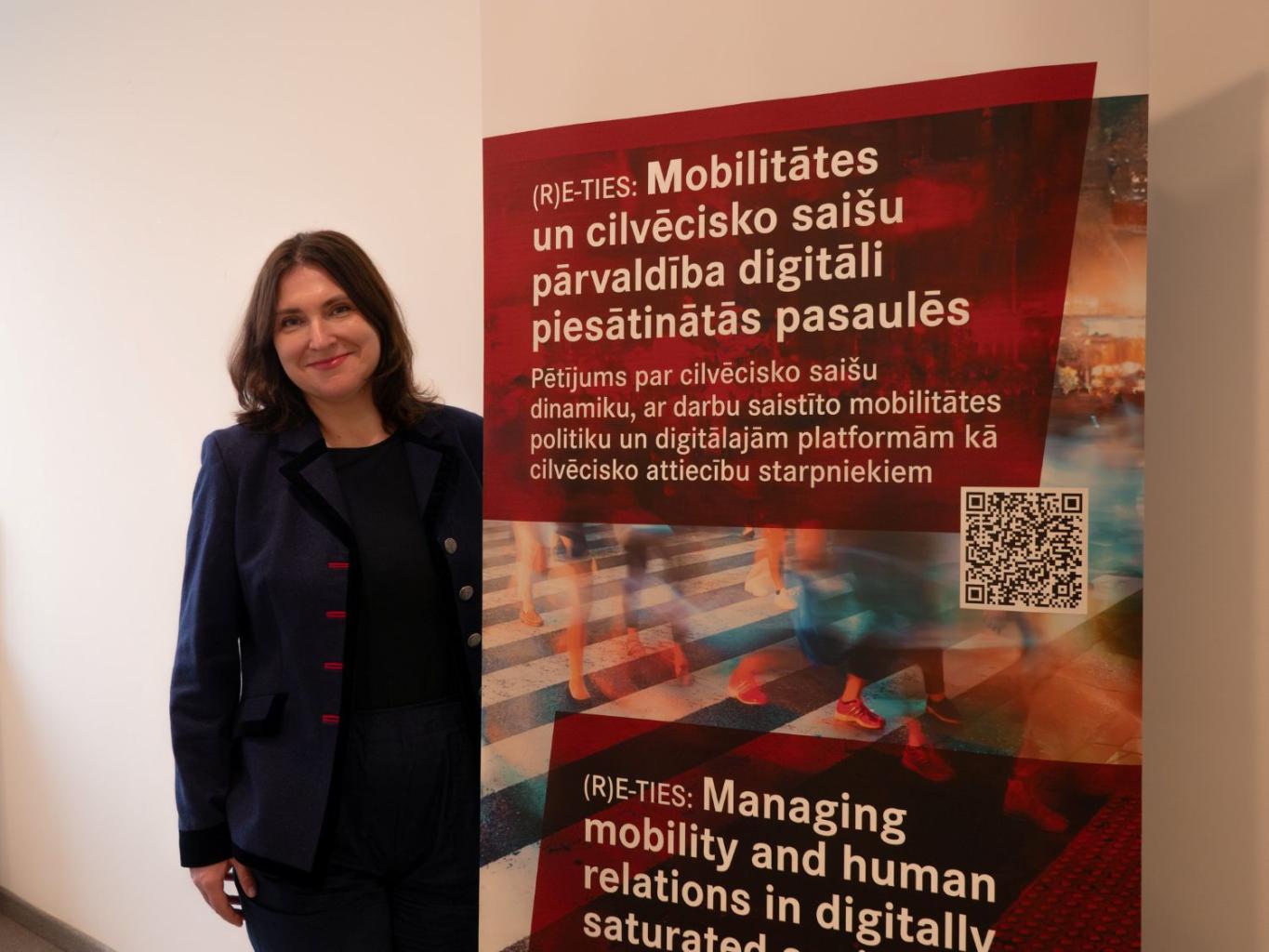
This topic continues to be explored in the (R)e-ties project by Klāvs Sedlenieks and other colleagues, who are examining how social and emotional ties can be maintained across national borders and what challenges this entails. I think we all know these sometimes harsh stories of partners living in different countries and the great uncertainty that comes with this situation.
In many parts of Europe, there is an oversupply of professionals with doctoral degrees, but this is not the case in Latvia. And we want to attract talented specialists.
I believe that RSU stands out among educational and research institutions in that we seek the best solutions for attracting leading professionals and ensuring that they do not lose ties that are important to them.
RSU has attracted excellent tenured professors from all around the world, and we have a relatively high number of international researchers and professors.
There are a number of international colleagues working at the Faculty of Social Sciences, for example, Visiting Professor Rico Isaacs, who studies populism and has established ties between our faculty and the University of Lincoln, United Kingdom. Postdoctoral researcher Aizhan Sharshenova from Kyrgyzstan works with us. She currently lives in London and works with us partly remotely.
I would like to especially thank the RSU Human Resources Department, which seeks and finds opportunities to address these matters. Rector-level decisions are equally important, allowing us to attract high-calibre specialists. We recognise that these people are not always physically present at RSU daily; however, it does not hinder full-fledged cooperation and high-quality work.
You have an international education yourself, and now, for over 10 years, you have been working at RSU.
Yes, indeed (with surprise) – it has been ten years!
What was it that attracted you to our university? After all, you had opportunities to continue your work abroad, even in Japan.
My return to Latvia was also determined by personal circumstances. However, it was specifically RSU that was open and inclusive to my international experience. At that time, several circumstances coincided successfully – Klāvs Sedlenieks had engaged in the Horizon project INFORM, and he invited me to join as one of the researchers. This gave me the opportunity to work full-time without looking for additional opportunities. At RSU, I saw many good prospects for development and collaboration, which I greatly appreciate.
I would also like to add that my mother once worked at RSU when it was still the Medical Academy of Latvia – she is a biochemist. I remember when I was a child, the first international students would call her at home, and she would help them solve everyday issues. In a way, my work at RSU is a story of return.
Years ago, I attended Christmas parties at the Medical Academy of Latvia, and now I am delighted to take my daughter to the Christmas events.
This personal connection is very important to me and was another reason for RSU to become a place where I truly want to work.
Your path in science has been unconventional. In one interview, you talked about your choice to pursue your first higher education in Asian Studies, where you studied the Japanese language. I got the impression that you were following your own path even at a young age.
Yes, that is indeed true, it was certainly a conscious choice, and I am very happy about it. Looking back, I am grateful to my parents, who never dictated what I should do or study and did not encourage me to choose “the programme that everyone studies.”
Can you speak Japanese?
Yes, I can, although I must admit that I have lost some of my skills, as I do not use Japanese on a daily basis. However, I follow the news and maintain professional ties with colleagues at several Japanese universities, and we continue to collaborate.
Please tell us more.
I collaborate with colleagues at Keio University in Tokyo, as well as at Tohoku University, located in the city of Sendai. For example, my “contact person" at Keio University is Assoc. Prof. Greg de St Maurice, with whom I studied during my doctoral studies. He has also delivered guest lectures in Latvia and is currently an affiliate researcher at the Social Sciences Research Centre as part of our affiliate researcher initiative.
In conducting research related to Japan, I have received significant support from colleagues at several Japanese universities.

You are an anthropologist. It seems to me that anthropology particularly vividly demonstrates how diverse the possibilities and approaches to one and the same experience can be. I remember an interview in which the interviewee spoke about the life in multinational Thailand, where very different cultures and ideas coexisted. At the time, she was a young mother and admitted that it was there that she felt accepted for the first time, regardless of her choices. Very different choices were considered acceptable there both in terms of childbirth practices and attitudes towards returning to work or staying at home. In Latvia, by contrast, the role of motherhood is still often dominated by rather strict and unambiguous perceptions. In my opinion, an anthropological perspective can also be therapeutic, as it allows us to see how differently people can live, think, and choose...
That’s true! (reflecting) Within any society, there are many differently thinking groups, and in social anthropology we look both for the similarities and the differences. This year, the FLPP project Caring for Democracy: Life-Making Practices in Geopolitical Uncertainties (LALIFE) has been approved, in which we will continue to study the ties that unite us, yet now in a different context – in Latgale, under conditions of major geopolitical uncertainty. I am the project manager, and we will launch it in January 2026. I have a fantastic research team: human geographer Aija Lulle, communications researcher Elza Lāma, network scientist Valdis Krebs, social anthropologists Diāna Kiščenko and Anna Žabicka, as well as doctoral student Karlīna Grīviņa and master’s student in social anthropology Aiga Ļaksa. We will focus on Latgale, analysing how communities enact democracy in their everyday practices – not from the perspective of a capital city, but from the daily experience of a region.
We are interested in how different groups of people, who are often symbolically “excluded” from the rest of Latvia, build mutual connections.
We also want to understand what we can learn from this experience for strengthening democracy and how we think about the country and society to which we belong.
Is this the study about which information has circulated publicly, stating that the focus groups will include young mothers and hunters?
Yes, in this study, mothers, young people, and hunters have been selected as the target groups. Hunters are people with in-depth knowledge of forests, nature, and territories, yet relatively little research has been done on their social relationships and daily practices. Therefore, we are interested in how hunters form their social relationships, how they use their knowledge, and how they understand their sense of belonging to Latgale and Latvia as a whole.
The study will also analyse the experiences of mothers and young people, paying particular attention to their participation in civic activities.
Will the study involve qualitative interviews or joint walks in the forest, as is typical in anthropological research?
Yes, among other methods, participant observation is also planned, and one of my colleagues has already begun a small preliminary study by actively engaging in the activities of a hunters’ society and gaining initial insights.
In the anthropological approach, the emphasis is on spending more time with the people who are participating in the study
so that we can understand not only what they are saying about something, but also what they are actually doing for us to perceive the unspoken layers, the things that can never be understood through questionnaires alone.
In addition to participant observation, the study will include qualitative semi-structured interviews, a quantitative survey and social network analysis. Overall, the study is designed as an interdisciplinary project, and we are open to new methodological developments in the course of it.
Who would you recommend studying Social Anthropology to?
I would especially recommend it to people who are actively working in some professional field and feel that they need more in-depth knowledge about society in a broader sense – both about the society we live in Latvia and humanity as a whole. It is suitable for those who realise that our everyday experiences are part of a broader global process and who want to better understand the social relationships, values, and contexts that shape human behaviour.
At the same time, we strongly encourage people who want to work in science and research to be in an academic environment.
Studies in social anthropology require time and in-depth involvement – it is not possible to carry out data analysis in five minutes. There is a great deal of reading and thinking involved.
And you should do it by yourself! Artificial intelligence will not be of much help here. One must be able to critically evaluate information and present arguments – these skills are purposefully developed in the programme.
You are also Acting Dean of the Faculty of Social Sciences (a competition for the position of Dean has currently been announced). How are you doing in this position?
There are many ideas about how we can continue to grow and develop further. During the reorganisation, Karina Palkova has definitely laid a fantastic foundation by establishing the Faculty of Social Sciences and creating a unique governance structure based on study programme groups – the ship has been set on a very steady course. Now, our task is to think about the future: which study programmes to offer in two, five, and ten years’ time.
Social sciences are an essential part of the university. We are already actively collaborating with colleagues in the field of healthcare, but I see potential for even closer cooperation. It is precisely in this way that we can jointly think about how to address the complex global challenges we face.
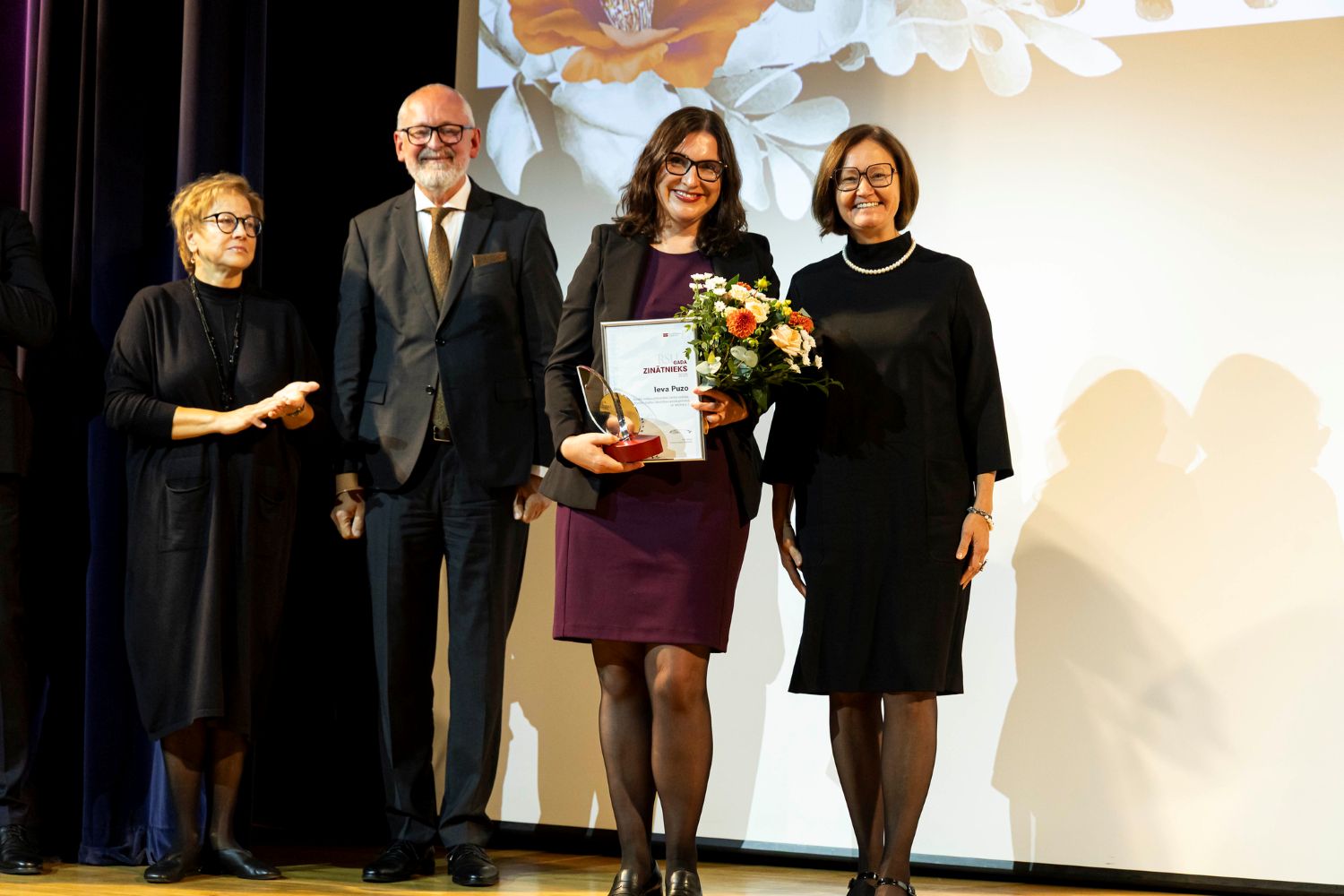 Receiving the RSU Annual Award 2025 on 2 October 2025 at the Academic Meeting. From left: Prof. Ilze Grope, Rector Prof. Aigars Pētersons, Ieva Puzo and Vice-Rector for Science Agrita Kiopa
At one of the career days lectures, the speaker enthusiastically emphasised how significant artificial intelligence is already in the communications industry, adding that in the future, several communications-related professions might become practically unnecessary. What is your view?
It seems that lately every decade has proclaimed some new technology as something that will completely transform the way we communicate. Often, these visions are accompanied by the idea that humans will no longer need to do anything.
However, each of these potentially utopian ideas are fairly quickly confronted with reality.
I think it will be similar with artificial intelligence: yes, it is here and it is here to stay. But it is important to understand that it is still a tool, whereas thinking is our own activity.
And it is precisely this mental work – critical thinking, fact-checking, the ability to see through the superficial level that daily artificial intelligence tools produce – that will be the skills we need to strengthen.
This is the contribution that experts in the field of social sciences, including RSU, can offer to society, and it will be greatly needed.
We cannot escape artificial intelligence tools, nor is there any need to avoid them. However, our true strength still lies in our humanity and our ability to critically assess what we need, what we do not, and how to use these technologies responsibly.
In conclusion, I will return to Japan. What can we learn from it in terms of our work culture? And what can they learn from us?
We can learn that productivity is not an end in itself. In Japan, people work very, very long hours, and work is extremely important, but it is not carried out in a way that makes every contribution “metrically measurable”. Of course, extremely long working hours have their downsides, but I think their approach offers a slightly different perspective on why we work. Sometimes, it is important that there is a person employed even if their only job is to press the elevator button or sweep leaves from a tree.
And what can Japan learn from us? Quite the opposite – that there are moments when the number of hours spent at work does not equate to results.
Related news
 RSU Researcher Anna Žabicka Receives International Recognition for Her PhD DissertationRecognition, Social anthropology


