Baby steps: RSU scholarship recipient, choir singer, prospective doctor Lauma Māra Vikmane shares her story


Photo: Courtesy of Lauma Māra Vikmane
We often imagine medical studies as constant learning, sleepless nights, and immense responsibility long before the first day at work at a medical institution. And that is true. However, a future doctor is also a person with their own interests, routines, exhaustion, joys, and ongoing search for balance between professional and personal life. For Lauma Māra Vikmane, singing in a choir provides this balance.
She is a sixth-year student at the Faculty of Medicine of Rīga Stradiņš University (RSU), preparing to earn her medical doctor’s degree and choose a residency specialty. Alongside her intense studies, Laura Māra sings in the RSU mixed choir Rīga, performs in concerts and competitions, and has experienced what it means to receive a scholarship not only as practical support, but also as recognition that her hard work has been noticed.

How did you find your way to RSU and medical studies?
Once I realised that I wanted to study medicine, it was clear that I would do it in Latvia. As a child, I grew up living near RSU, and the university has always been close by to me. When the time came to choose where to study, RSU felt like the natural choice.
The medical programme involves six intensive years of study to earn a medical doctor’s degree. This is my final year of study. Then in the summer, I will have to apply for residency, where I can already specialise in a particular field.
Have you already decided on a field?
Many of my group mates have a clearer idea of their specialty. For me, I have not figured out it yet. That is why I am currently considering internal medicine. It is a broad field that covers diseases of various organ systems - the kidneys, the gastrointestinal tract, and many others. I think it is valuable to stay in a broader field for a while longer and explore different areas. Perhaps, residency will help me realise which field to pursue.
Residency means another four or five years, but it is a different stage where you are both learning and working at the same time.
Medicine is a long and hard road. How did you come to this choice?
I love learning. That is probably one of the most important reasons. Besides, medicine has always been part of my family. My parents are involved in medicine, as is my godmother. The environment where I grew up definitely influenced my interest.
Even as a child, I wanted to understand how the human body works. When I was ill, for example, I would ask my parents: why do I get a runny nose? I was curious about how the body functioned as a whole.
In a way, it is also a continuation of a family tradition. Someone has to carry it on.
What do you enjoy most about studying medicine?
I really enjoy the practical side of medicine. Of course, medical studies involve an enormous amount of theory, and a lot of time is spent studying from books, lecture notes, and presentations. But it gets especially interesting during clinical placements.
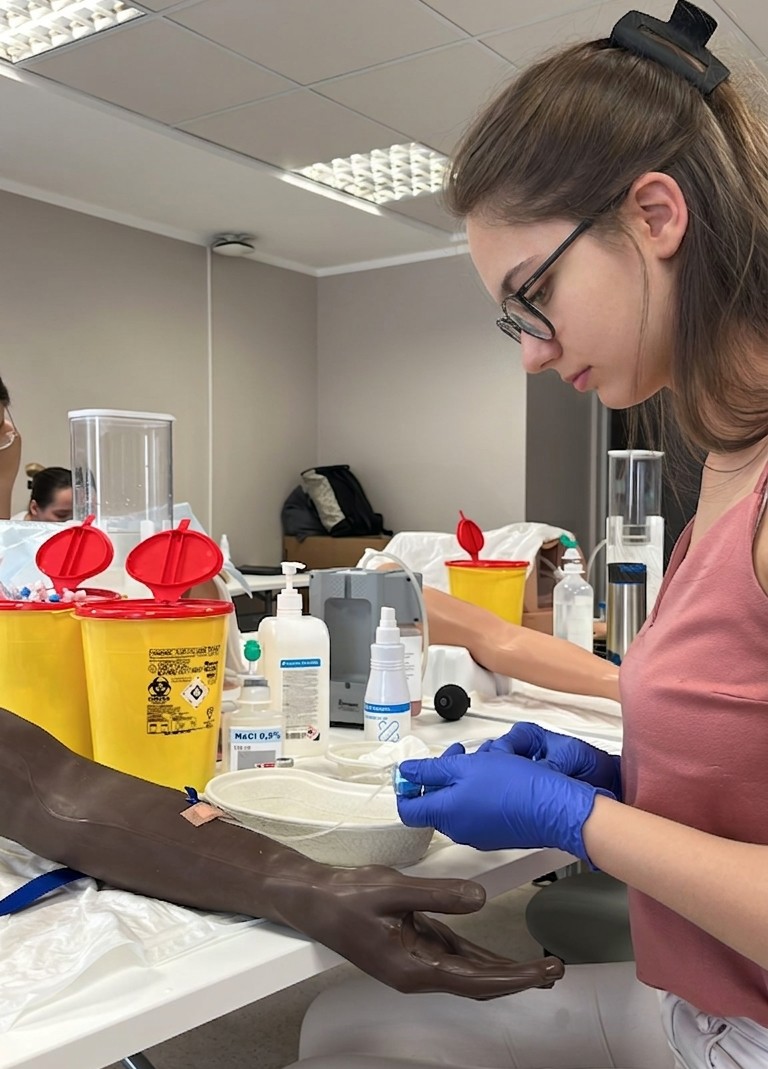
This year, we had more placements, and that is a whole different challenge. We are taught to perform specific procedures, like how to intubate a patient or administer injections. At that moment, you realise you are learning something very real. And to be honest, sometimes I get the feeling: I am a hero because I know how to do this.
What is the most challenging in your medical studies?
The sheer volume of material. Medicine is a very broad field. There are various courses, different diseases, different organs, and different systems. And then there is an exam, where you are expected to know it all.
Sometimes it feels overwhelming. But it is also a value - you really have a vast amount of knowledge.
Do medical students even get to enjoy student life?
Yes, absolutely. We have had group gatherings, parties, and joint events at Christmas or during the summer. Now, towards the end of our studies, we meet less often, but that does not mean life is all about studying.
The choir is very important to me. When I go to rehearsals, I can put medicine aside, at least for the duration of the rehearsal. If I have an exam at eight o’clock the next morning, I might bring some study materials with me. But overall, I believe that it is possible to enjoy the process even while studying medicine.
How did you start singing in a choir?
I have been singing in choirs almost every year since first grade. My parents also sing in a choir, so in childhood, it felt natural. My parents would say: you should join a choir. And I did.
Over time, the choir became a part of my life. I did not sing in my first year at university because it was during the Covid-19 pandemic; everything was done remotely, and I did not sign up. But from my second year, I joined the choir. It happens very naturally for me - wherever I live or study, I look for a choir to join.
Even when abroad, I have always tried to join some local choir, if possible. In tenth grade at school, I was in Austria on my own, and I joined an Austrian choir. It was the year of the Song and Dance Festival, so I wanted to be involved with a choir to go to the Song and Dance Festival in the summer. In 11th and 12th grade, I lived in Switzerland with my family, and we joined a Swiss diaspora choir.
What does singing in a choir mean to you?
Choir makes my life more interesting.
Medical studies take up a lot of my time and thoughts on a daily basis, but in the choir, I can shift my focus completely. It is a different way of thinking, a different kind of focus.
I sing outside rehearsals as well, but choir is not just about singing. It is teamwork. There are people, friends, conversations, social interaction. There is always someone to talk to. It is a place where you can simply enjoy the music and be part of a shared musical harmony.
What do you enjoy most about the choir repertoire?
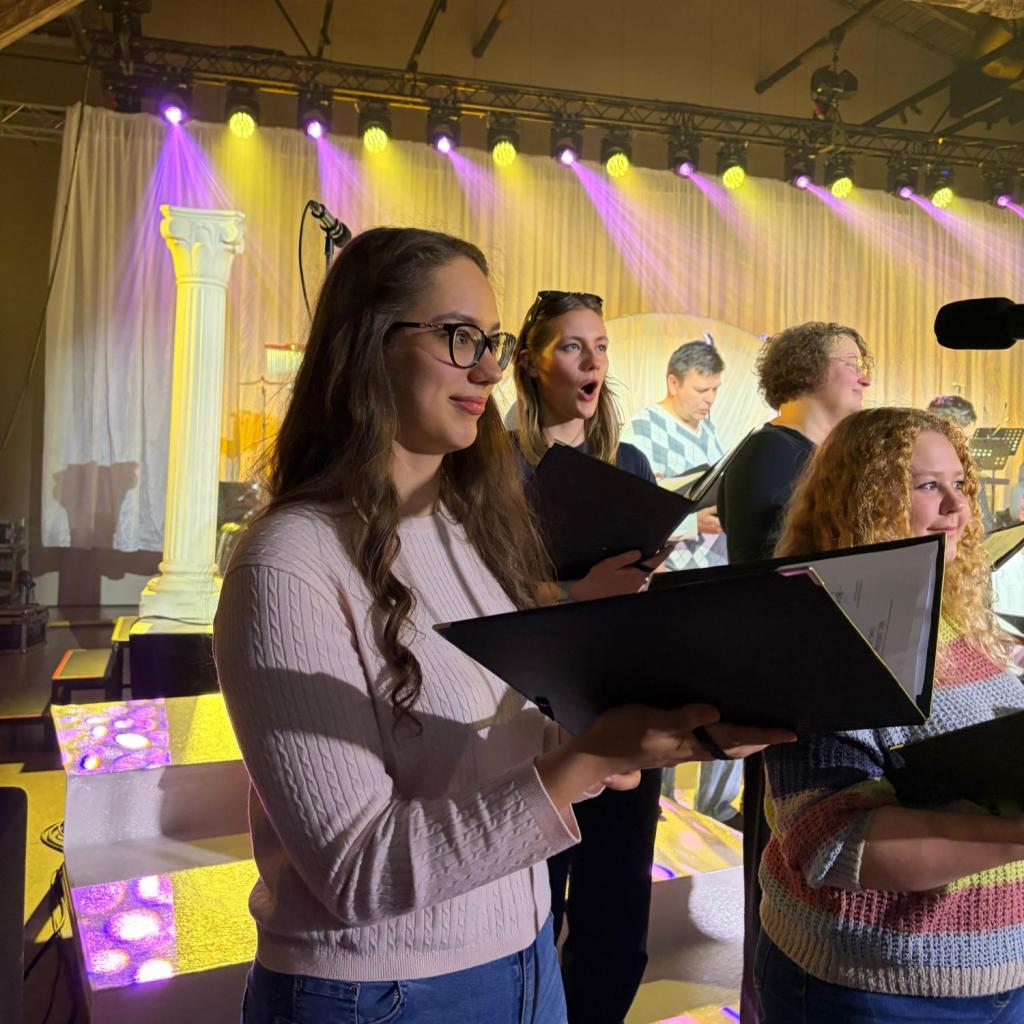
The repertoire is usually closely related to events and competitions, and to a large extent, it is chosen by the conductor. We have performed some very interesting Georgian pieces. This year, we also worked a lot with more contemporary repertoire. Recently, we took part in a choir competition in Riva del Garda in Italy, where we won several awards, including the Grand Prize.
Modern compositions tend to be very complex at first. Sometimes, when you look at the sheet music for the first time, it is not even possible to understand where the music lies. But then each voice learns its part, everything gradually comes together, and the rhythm, the overall structure, and the full sound emerge. That is exactly what I find most fascinating. The moment when the complex piece finally starts to sound right brings a special sense of satisfaction.
At the moment, we are also preparing for the XX Baltic Student Song and Dance Festival Gaudeamus, and the repertoire includes both well-known and less-known Lithuanian and Estonian songs.
How is it possible to balance choir and medical studies?
Our conductor often says: if you sing in a choir, you have already made the decision that it is a must. This is helpful, I simply plan my evenings so that when there is a choir rehearsal, I have to be there. Then I look at my daily schedule - when I need to be in lectures, when I need to study. I plan my life accordingly. If I know I have a choir rehearsal in the evening, I study earlier in the day. It requires more advance planning, but overall, it helps me become more organised.
The main thing is to accept that choir is important to me. Once it is done, I find the time.
What do medical studies and signing in a choir have in common?
It is teamwork.
In a choir, there are many voices, and each one has its own role. Everyone works together to create a single unified musical harmony.
In medicine, it is similar. Teamwork is extremely important, as everyone works towards a common goal - to treat a patient. Each person has their own role, but the result only comes about if we can cooperate.
The difference, perhaps, is that in a choir we follow the conductor very clearly. They are the leaders we all follow. In medicine, there are senior doctors who give guidance, but you also have to learn to stay on track yourself and remain focused on the goal - the treatment of a patient.
Does singing in your university’s choir give a special sense of pride?
Yes, it does. I have sung in various school choirs, and whenever you have someone behind you to represent, it brings an added sense of responsibility and pride. You are representing your school, your university, your community. It also gives a sense of support.
What are you most proud of from the past year?
It is definitely the choir’s victory at the competition by Lake Garda. It was a major achievement for the choir. On a personal level, I am especially proud that my student research paper was published on an international journal in Lithuania. I am truly proud of that.
How did you learn about the RSU Foundation scholarship opportunity?
Both the conductors and the scholarship recipients from previous years spoke about it in the choir, which encouraged me to apply.
How did you feel when you found out about the scholarship award?
It was a wonderful feeling. I was very happy.
Of course, the scholarship is also a practical support, but at that moment, the greatest joy came from the recognition. You receive a message that you have been selected, and it means: someone has noticed your work, your academic performance, your contribution.
I think that this feeling of recognition was the most powerful. It says: what you are doing is valuable.
What did the scholarship give you - practically and emotionally?
In practical terms, the scholarship helped with daily expenses. For example, it allowed me to buy a monthly transport ticket so I could travel between my various study locations and choir venues. There were also choir trips that required additional funding from the singers. RSU covers a lot of the costs but longer trips still require a co-payment.
Emotionally, the scholarship also gave me a little freedom to treat myself. After writing a good paper or giving a presentation, I could afford to buy myself a snack, like some chocolate.
 What have medical studies and choir taught you?
Medical studies are a very intense process, and together with choir, they have definitely made me more organised. You have to attend lectures, prepare for tests, colloquiums, and exams, and find time for studying and rehearsals. To manage it all, everything has to be planned.
I focus on what I need to do and where; when I need to prepare for what, and then I try to make it all work. There is simply no other way.
The choir, on the other hand, has been part of my personality since first grade. It has probably made me more friendly and open. In the choir, there are all kinds of people - students, residents, people not directly related to medicine. It is an opportunity to meet people outside your usual bubble.
Have there been moments when you thought: maybe I should put the choir on hold?
Yes, especially during my third and fourth year of studies. Those were very intense. Around exam time, when there were so many tests, the thought tended to pop up that maybe I did not need all of that.
But I have never thought about leaving the choir entirely. Rather, sometimes I think maybe I can skip one or two rehearsals to get done what needs to be done urgently in my studies at that particular moment. But the choir has always been important to me.
Was there ever a moment during your medical studies when you wanted to give it all up?
No, not to quit. As a person, I generally find it hard to quit things I have started. I feel once I have started something, it must be finished - for better or for worse but finished.
It was hard during Covid-19 period, as I started my studies right at the time when everything happened remotely. I found myself in a completely new environment - I was no longer a school student, I was a university student, yet I did not have the usual personal contact with my groupmates. It was hard to get used to a different structure and learning pace. But I never thought about dropping out.
What helps you get through difficult moments?
Focusing on small achievement helps me.
When it feels like there is a huge amount of work ahead, such as a hundred pages to read before an exam - it can be frustrating. Then I try not to focus only on the huge mountain of work, but instead on small steps.
For instance: I have learned two questions from that huge material. That is already something. I like the feeling of having the work done. If I skip a choir rehearsal because I need to finish something important, there is still a sense of satisfaction once I have done the work. I try to hold on to those small positive achievements.
Why is it important for the university and its patrons to support not only science or matters directly related to studies, but also culture and sports?
It helps develop well-rounded professionals. In a choir or in sports, people learn teamwork, concentration, responsibility for results, and the ability to work persistently to achieve a specific goal.
In a choir, for example, you have to be fully present for a three-hour rehearsal. You have to repeat, sing once again, refine, follow others, and maintain focus. I am sure it is similar in sports.
These skills are later useful in professional life. A well-rounded person collaborates better, fits into a team more easily, and is able to work steadily towards a goal. That is why support for culture and sports is not just separate from studies - it helps develop a person as a whole.
What would you say to a student who is wondering whether to apply for the scholarship?
I would definitely suggest applying!
Applying also means knowing how to present yourself. And it is important to learn how to do it. The best thing that can happen is that you receive the scholarship and recognition. The worst thing - that you do not get the scholarship this time, but at least you tried. That matters, too.
I think that in general, it is worth trying things. Not just with scholarships, but with the various opportunities that life offers. By trying, you may also discover something new about yourself.
What would you say to someone who is considering donating but thinks: what difference can my five or ten euros really make?
I would say that it is an investment in the development of students and future professionals.
It is not 'just ten euros'. When a student receives a scholarship, they also receive recognition. They feel that they have achieved something valuable and that someone has noticed it.
Financial support helps in very practical ways - it gives students more time for studying, helps them get to lectures, participate in choir, sports, or other activities. Even a small amount of support can be very meaningful for a student. It can reduce everyday stress and allow them to focus on their studies and professional growth.
That is why this kind of support provides more than just money. It gives time, recognition, and the feeling that you are not alone on your journey. And for a student, it can be irreplaceable.
Join our supporters by making a donation through our platform!

Conclusion
Lauma Māra’s story is not only about one scholarship or the everyday life of one student. It is a story about how a future professional is shaped - through knowledge, discipline, curiosity, teamwork, and the ability to move on even when it gets difficult.
Medicine demands precision, responsibility, and resilience. Choir demands listening, harmony, and presence. In both fields, results come only when a person does their part while also seeing the bigger picture. That is why supporting students is not just about helping a specific person at a specific moment. It is an investment in people who will later care for others, work in teams, make difficult decisions, and shape the future of society.