It's important to encourage girls to get into science: RSU tenured professor on inspiration and research in paediatric oncology


Author: Linda Rozenbaha,
RSU Public Relations Unit
We continue our series of articles introducing the tenured professors of Rīga Stradiņš University (RSU). This time, we introduce Acting Tenured Professor Mirjam Eleonora Blattner-Johnson from the RSU Institute of Oncology and Molecular Genetics.
In the interview, she talks about her research in molecular biology and precision medicine in paediatric oncology, which opens up new, more targeted and less invasive treatment options for children and young adults. She also shares her journey in science and emphasises how important it is to support girls’ interest in science, as career opportunities are still unequal – ‘I truly admire every woman who manages to reach a higher professional level while raising a family.’
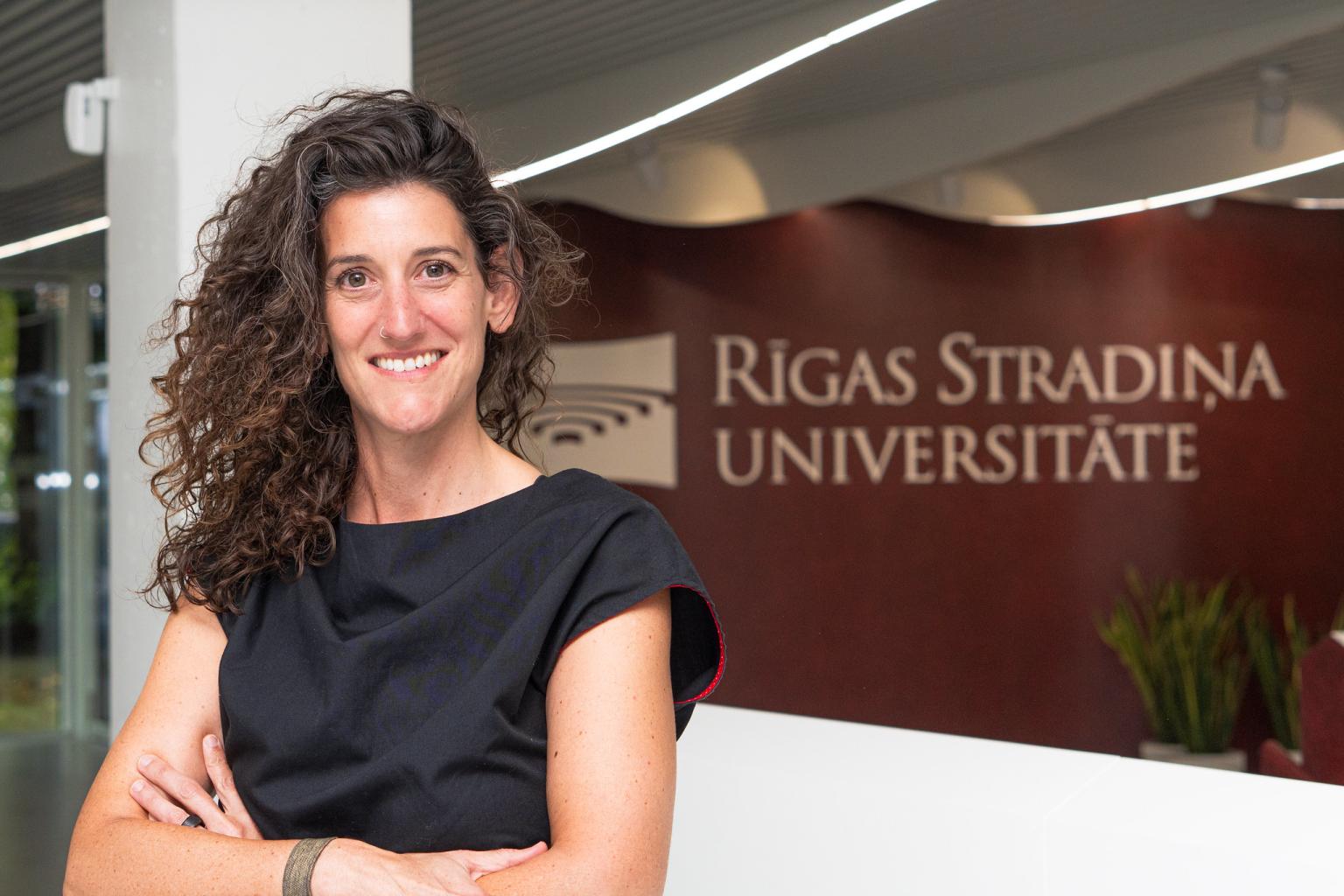
Acting Tenured Professor Mirjam Eleonora Blattner-Johnson
The tenured professor lives in Heidelberg, Germany. However, she regularly travels to Rīga for work – usually for two to three days per month. These visits are typically scheduled around important face-to-face meetings or events. After spending a couple of days in Latvia, she returns to Germany to continue her work at the German Cancer Research Center (DKFZ).
To help the RSU community get to know you better – both as a person and as a scientist – could you share what sparked your interest in science and how your journey began?
I have always liked natural science. I still remember when I was in high school, some people from a famous research centre in Berlin visited our school.
They showed us how to extract DNA and introduced us to the world of molecular biology. And that was the first moment I said: ‘I want to study molecular biology.’
I actually think about it from time to time. Just recently, I went to my daughter’s elementary school to show them some science experiments. Why? I believe it can really spark something, especially in girls. I think it is important to encourage girls to get into STEM fields, because I still remember how impressed I was back then to actually see science in action. Science – it is not just theory but a dynamic and inspiring field full of creativity, collaboration, and real-world impact.
There is the technology part too, which has always fascinated me. I remember being there when the first next-generation sequencers came to our lab at the Max Planck Institute in Berlin – we were literally screwing parts onto the machines ourselves! I like understanding how things work.
And then you began your studies in Austria, later going to Germany, and New York in the United States.
Exactly, first I went to Austria, where I completed my undergraduate studies – it was actually really interesting because the programme was based at a university for veterinary medicine and we took the same classes as the veterinary students. It gave me a really strong foundation in medical and biological sciences, even though it was focused on animals.
Then you decided to continue your studies back in your home country, Germany. What motivated that decision?
I went to Berlin – to the Max Planck Institute, which is a well-known research institute in Germany. At first, I only planned to stay for a few weeks. It was through the Erasmus programme, just to gain some lab experience. I really liked it, and I decided to finish my studies in Berlin. So in the end, I completed my master’s degree in Berlin.
And then from Berlin, well, I never really planned to go to the US – to New York, of all places. My future supervisor came to our institute to give a talk. It was actually the first time I had really heard of precision medicine. I found it intriguing.
So, he asked me if I would be interested in joining his group at Weill Cornell Medical Center in NYC for my PhD. Officially, I was still enrolled at Humboldt University, but I carried out my research in New York. I ended up living there for about seven years, and this is where I truly learnt to think like a scientist.
And what was your path to joining RSU?
 After New York, I went back to Germany, to Heidelberg. I joined a group at the DKFZ, focusing on precision medicine in paediatric oncology patients. My current supervisor was invited by the Children’s Clinical University Hospital (BKUS) in Latvia to give a talk at the Precision Medicine Forum (PMNet) here in Rīga back in 2023. But since he was not available, I went and gave the talk.
About a year later, I was contacted by a recruiting head-hunter who asked if I would be interested in applying for a joint position between RSU and BKUS.
When I was first invited to apply for the job, I thought: I had two small children, and it was a big decision. But then I thought it would be interesting to at least see what the position entailed.
I believe we have knowledge worth sharing. I am not saying that this country is underprivileged by any means, but I do think Heidelberg is probably a step ahead with the resources and knowledge we have in certain areas of science. So,
I figured I could be of some help by bringing some of that knowledge here, especially to help children with cancer.
Then, the idea regarding a joint position between RSU and BKUS arose. It is a similar setup to what we have here in Heidelberg, so it was not entirely new to me. I really enjoy working in a transnational context.
They offered me a full-time position, and I gave it a great deal of thought because of my affection for Rīga, as well as the excitement I could sense from many people at RSU and BKUS about this possible project. But, as my kids and I had just moved from the US, I did not want to uproot them again. So I decided to take the part-time option – and I have been here ever since.
Would you be able to tell us more about your research here at RSU for the wider RSU community?
The research here at RSU is very closely connected to BKUS, and it is patient-based research – exactly the kind of work I enjoy. I have several projects, with some in collaboration with other great group leaders here at RSU who really support me and help out, since I am not here that often and rely on their assistance.
One of my projects focuses on understanding the Latvian paediatric cancer cohort. It will also emphasise simply looking at the numbers: How many children are diagnosed with cancer? What forms of cancer do they have? What are the survival rates? This data has, in part, already been generated by BKUS in collaboration with the Latvian Biomedical Research and Study Centre.
What makes Latvia special is that there is only one children’s hospital. In Germany, for example, there are so many, and it is often tricky to collect complete information because hospitals do not necessarily collaborate or share data easily.
Here, every child – whether it is cancer or another rare disease – comes to the same place. So we can see the entire disease history in one dataset, which is actually a huge advantage for research.
From my perspective, I am interested in correlating clinical data with molecular data. The national cancer registry provides demographic and diagnostic information in addition to that which is recorded in the hospital, and we will connect this to molecular outcomes, as for many patients, this type of data is already available to us.
The other project that I am really excited about – and this is very closely connected to RSU – is something we started in Heidelberg a while ago: a drug screening programme.
Basically, there are two approaches. One is to look at the DNA and RNA of the tumour, and figure out on a molecular level what is broken in the cell that makes it so aggressive. Usually, when a cell behaves abnormally, the body recognises it and eliminates it – this happens all the time. But, in cancer, something about the cell allows it to escape detection and the internal control system. So, you can study the tumour, find what is broken, and then target it with specific drugs – what we call precision medicine, with the treatment being tailored for each patient. This is one approach, and it is already being done at BKUS.
The other approach says: okay, this is great, but sometimes, even when we know what is broken and think that because of the finding, the tumour should be particularly vulnerable to a certain drug, it still does not work or not as well as we hoped – because cancer cells are incredibly complex. They can find alternative ways to survive, or even push the drug out of the cell.
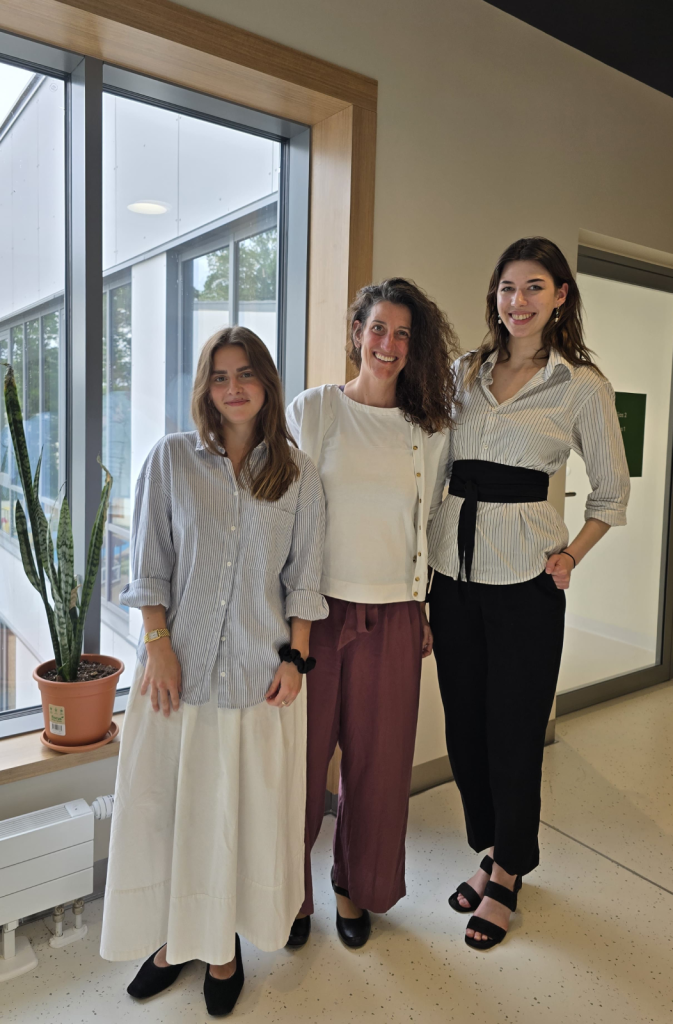
With colleagues from her team, RSU student Grieta Dubults (left, helps in patient data management) and Anna Millere, student at the University of Latvia (engaged in drug sensitivity screening)
So, another method is to take cells directly from the tumour, grow them on small plates, and expose them to a set number of different drugs – this is drug screening/drug sensitivity profiling.
Right now, we are developing a pipeline that allows us to test around 130 approved drugs on patient-derived cells, to see which ones actually kill the cells most effectively.
We are currently building this drug screening unit at RSU, and I have two students coming to Heidelberg to learn the methods, so we can later establish the setup here as a core facility. I hope that, by 2026, we will be able to test samples from 5 to 10 children.
Once the pipeline and workflow are up and running, it is planned to turn this into a core facility, open to other RSU research groups – so if someone says, “We have these cells, we would like to test these drugs,” they can come to us. Because not everyone needs to know all the technicalities. At least this is the long-term plan.
I have one question – both from a philosophical and a medical perspective. From the philosophical side – this is a very sensitive topic – when you work with medical data regarding seriously ill children, how do you deal with that emotionally? From the medical side: why are children affected by cancer – maybe it is genetic or due to some mutations.
Personally, I do not usually see and interact with the patients myself, as I am not a medical doctor. I work with the cancer material – I analyse the tumour and then talk to the doctors.
But having children myself, sometimes it can be hard. For example, I analyse a sample from a patient, and I see that it is from a one-year-old baby, and I know that we will not be able to help them.
By the time they come into our sequencing programme – not here, but in Heidelberg – most of them are already out of real treatment options. They only come to us when nothing else has worked. So yes, it is hard, as you can imagine.
But then, maybe in 5 % of these extreme cases, we actually find something – one specific drug that works when all the standard treatments have failed. Hopefully, this number will grow over time.
And having said that, please keep in mind that about 80% of children diagnosed with cancer will survive the disease and be healed, thanks to research and medicine. This is what keeps me motivated to work in this field. Because they are our children, right? They are so young, and every single success story means so much.
From the medical side, why do such young people get cancer? How much of it is genetic, and how much is just chance or some kind of random error?
Only about 10 % of cases have a mutation that is already inherited from the mother or the father, right?
For the vast majority, it is just bad luck. Something goes wrong very early, usually when they are still embryos – some random mutation happens, and this is how it starts. It is bad luck.
Already today, precision medicine offers significant opportunities for treatment. How do you see precision medicine evolving, because in medicine, ten years is actually a long time?
Actually, when it comes to children, the practice in Latvia is already more advanced than in Germany. In Latvia, every child diagnosed with cancer is sequenced.
I do not think it is the same for adults yet, because it is obviously much more expensive – but fortunately, there are only about 60 children per year who are diagnosed with cancer in Latvia, and their tumour is sequenced right away, which is great.
In Germany, sequencing only happens once a patient fails all standard treatments or the initial diagnosis indicates a high risk of death. Only then, after treatments are unsuccessful, does health insurance cover sequencing. That means that for many children, we still put them through multiple rounds of harsh drugs and therapies before knowing whether they will respond.
I think that in the future, we will be much better at recognising early on if it is worth exposing a child to a drug which most likely will not work.
Precision medicine is not just about finding new treatments – it is also about knowing when not to treat.
We should not put a child through chemotherapy that will make them sick and cause them to lose their hair if we already know that their tumour will not respond. With better data, we can skip that first step and go straight to the drug that is more likely to work – and with fewer side effects.
Right now, for the majority of tumours, precision medicine still comes in second place. It is not yet the first option, and of course, there are many forms of cancer where chemotherapy works very well. As harsh as it is, it helps many patients. But there is a subset of patients for whom it does not help – and for them, we need to bring precision medicine forward, and not only use it after everything else has failed.
Also, bear in mind that quite often, a failed treatment, not always, but often, makes the cancer more aggressive. So the earlier we can treat precisely, the better.
And there is another important difference between adults and children. If an 80-year-old patient receives radiation therapy, that person will likely live for another 10 or 20 years. But if I treat a five-year-old child with radiation, and the child survives, they could live for 80 or 90 years – meaning they will live with the possible side effects and late effects for a lifetime. Radiation, for example, can affect the developing brain or growing tissues. Some children who survive cancer struggle later with learning difficulties, growth problems, or other long-term side effects. So, with children, we always have to be much more careful.
You have already had the chance to get to know RSU, and you have been working here. What do you think about RSU, and what is your vision for its development?
I can feel and see how driven RSU is to strengthen the existing research. I do, however, see some challenges compared to Heidelberg – for me personally, one of the biggest is, for example, ordering reagents. It just takes so long; the process is quite slow. Of course, this is not something that RSU can control directly.
So far, everyone I have worked with here at RSU has been incredibly supportive – it is a monumental team effort.
I think that without my colleagues, it simply would not be possible. I am only here once or twice a month, so having such dedicated and kind people helping me, including my students, makes all the difference. I think RSU is going in the right direction. More core facilities would definitely help to make it easier to start new projects, but overall, the spirit and motivation is great. And all the bureaucracy – well, that is the same everywhere, it is just part of our job.
Do you have any personalities in science who inspire you – people you would like to be similar to, or perhaps some words or ideas that have inspired you along the way?
In all honesty, I cannot name anyone in particular. But in general, I really admire women in higher positions, because I know how hard it is to compete with male colleagues.
Is it the same everywhere?
Yes, it is. Especially if you want to have a family – it is hard, right? I am here in Rīga now, and I cannot drop my kids off at school in the morning and give them a hug. Sometimes, this can also provide a nice little break (smiles), but it is still a trade-off and not always easy.
When I gave birth to my first child in the US, I only had six weeks of maternity leave. Physically, it was really hard – I suffered, and so did she.
My second child was born in Germany, where I was able to take 10 months off, which was wonderful – I could be there for my baby and also for my older one. Of course, this means you have a 10-month gap in your career, right? So I truly admire every woman who manages to reach a higher professional level while raising a family.
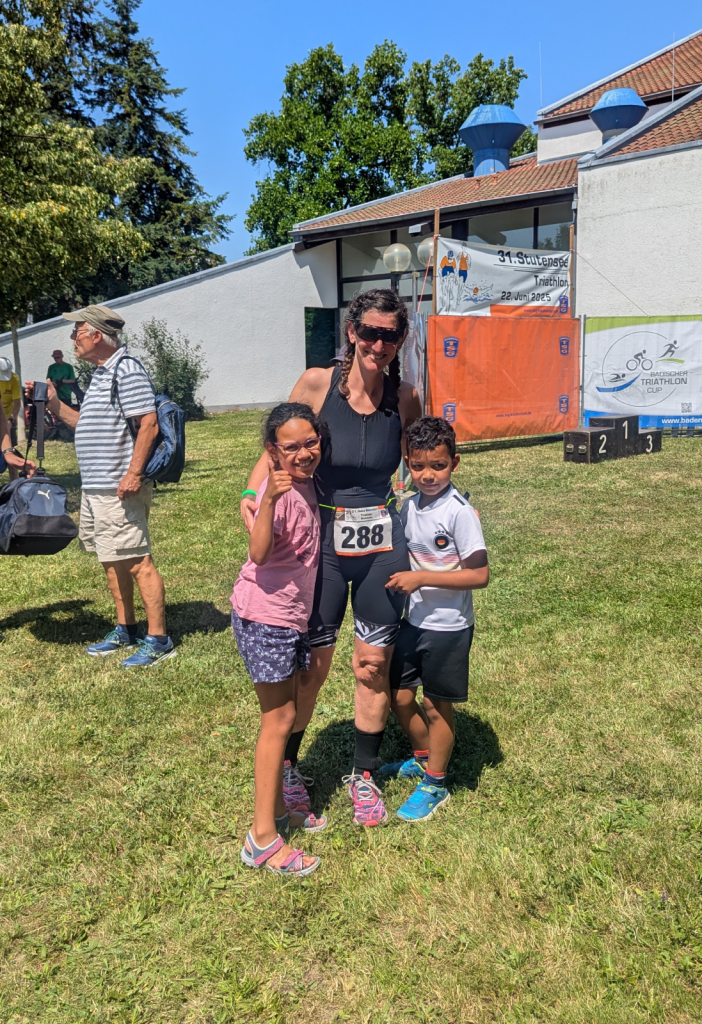
With her children after a triathlon race
Over the years, I got to meet and interact with so many admirable and smart scientists. And I especially admire those working in the paediatric cancer field. The patient population is small – which, of course, is a good thing – but it also means that there is much less drug development and less funding compared to more common cancers. I have met incredible paediatric cancer researchers who are so driven and passionate about their work, and I really look up to them – the whole community.
What does the daily work of a scientist look like nowadays?
Nowadays, I feel like a lot of science happens on the computer rather than in the lab. And I really miss being in the lab and pipetting! Luckily, I have great people doing the lab work for me – not all of it, but a lot of it.
First of all, I am a mum in the morning – until we finally get out of the house, it is chaos. I usually start work in the lab/office around 8:30 a.m., looking at genomic data. There is also a lot of writing, grant applications, communicating with students, and setting up collaborations.
The paediatric oncology field is so small that we collaborate on almost every project. It is a very international community because you have to work together to get the patients and the numbers – and this is something I really enjoy.
I spend most of my day thinking – which I actually love – but it also makes me really tired in the evening. I notice this more and more as I get older! I usually finish work at around 5:30 or 6 p.m., pick up my children, and then we go home. In the evening, after putting the kids to bed and cleaning the house, I like to watch some boring TV – after thinking so much all day, I just want to switch off. I also do quite a bit of exercise – about five times a week. I love swimming, biking, running, or yoga in the evenings. It really helps me recharge.
Do you continue running while in Rīga?
Since I do triathlon, I always go running here – and I love it. Usually, my visits to Rīga are quite short. I have not been to the sea in Latvia yet, but I plan to come back in spring for a whole week during the school break and bring my kids with me. I really want to explore different areas with them. I love the water here – and the smell of it, the fresh air mixed with the water.
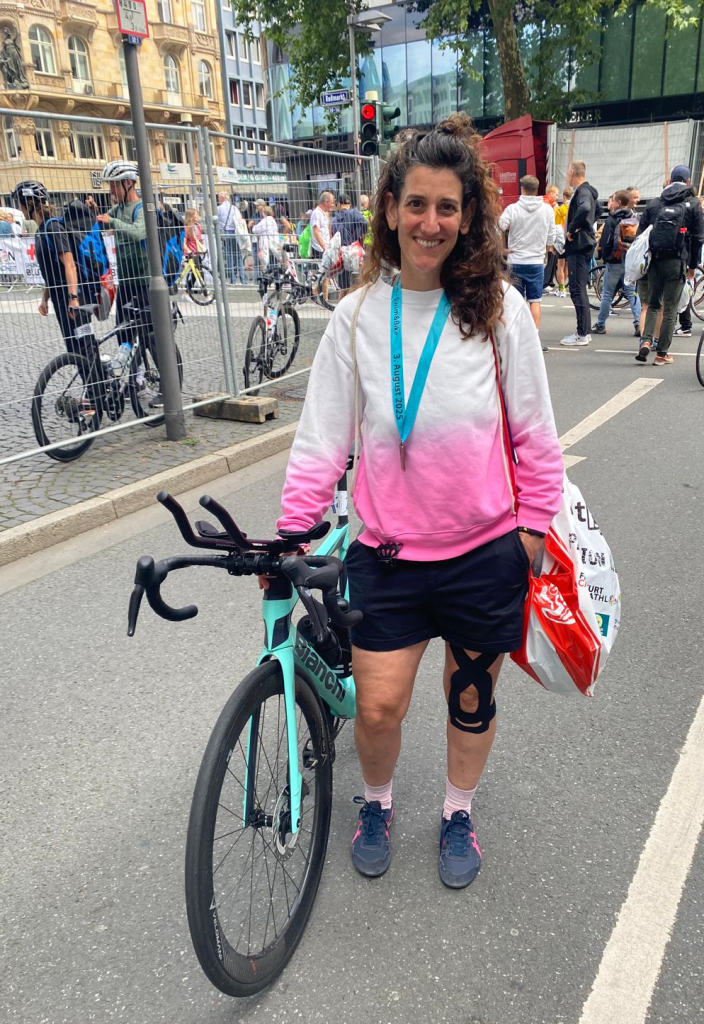
After a triathlon race
Finally, what message would you like to share with our RSU colleagues, students, and the faculty?
Science is cool. And to be honest (thinking a little bit), I sometimes feel that people think less of what they are doing than they should. Quite often, I hear things like, “Oh, you do it so much better,” or “We do not have X or Y, so we cannot do it.” But, actually, I think you already have so much – just try it; go for it! It might fail, but it might not. Sometimes we just have to try things out.
So, you mean we just need to believe in ourselves more – because we are already capable?
Yeah, absolutely! I understand – you are a smaller country, and everything abroad might seem so big and so fast. And yes, sometimes it is faster. But in the end, "we’re all cut from the same cloth*".
* This is similar to German expression, “Wir kochen alle nur mit Wasser”, which literally means “we cook with the same water,” but the idea behind it is that we are all human and none of us is doing anything better than anyone else.
Related news
 Piecing fractured bones back together: Dr Raitis Turkins on residency training in Jelgava RSU in the news, Residents' Stories, Graduate Medical Training, Interviews