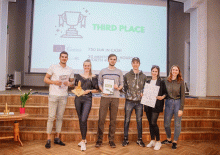
On 18 - 20 September, students from the Rīga Stradiņš University (RSU) Faculty of European Studies Department of International Business and Economics participated in a 48-hour Green Tech Copernicus Hackathon, which was held at Liepāja University. 66 students participated in the event. For three days the 16 teams looked for solutions to 16 challenges under the guidance of mentors. RSU was represented by two teams who won second and third place and valuable prizes.
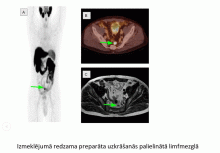
A team of scientists consisting of radiologists, nuclear medicine physicians, urologists, radiation therapists, oncologists, residents and students, have begun to implement the Fundamental and Applied Research Project ‘Impact of Targeted Molecular Imaging with FL-PSMA-1007 and 68Ga-PSMA-11 PET/CT in Multimodal Evaluation of Recurrent Prostate Cancer’.
Dear students!
Over the last week, COVID-19 cases have risen rapidly in Latvia. The situation is similar in many parts of Europe. Some coronavirus cases have also been identified among RSU students. These cases have been traced by the Latvian Centre for Disease Prevention and Control and by RSU. All contacts have been identified, and they are complying with quarantine requirements.

As the number of COVID-19 cases rises, Latvians over the age of 50 expect the government to implement the same measures and restrictions as in the spring. They voice that mobility restrictions should be imposed sooner and should be stricter, that health care for patients who suffer from chronic conditions should be improved, and that less support should be given to repatriation measures. These are the conclusions drawn by a Rīga Stradiņš University (RSU) and University of Latvia (LU) subproject, which was implemented under the National Research Programme.
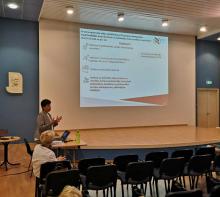
The researchers at RSU studying the effects of COVID-19 on sexual and reproductive health have just entered the qualitative research phase. Group discussions and individual interviews with policy makers and leading medical practitioners in the field of sexual and reproductive health are mostly held at Maternity Hospital in Riga, the biggest maternity hospital in Latvia.
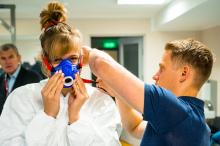
A team of researchers at Rīga Stradiņš University (RSU) has started to conduct research on the development of a safe and ergonomic protective suit under the direction of Professor Aivars Vētra from the Faculty of Rehabilitation. The suit needs to look good and is intended to be worn by physiotherapists, occupational therapists and other functional specialists.
The first International Simulation Symposium 'Experiences and challenges in simulation integration in Nursing and Midwifery' will be held on Zoom on 29 October, 2020.
On 15 October at 15:00, an award presentation will take place in the Rīga Stradiņš University (RSU) Great Hall.
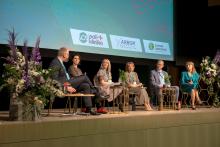
The main conclusion to come out of a discussion on women’s health organised by the Health Centre Association at which lecturers and researchers from Rīga Stradiņš University (RSU) participated is that women all too often neglect their own health.
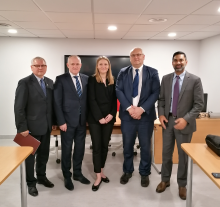
On 1 October, Jānis Grasis, the Vice-Dean of the Rīga Stradiņš University (RSU) Faculty of Law, Aldis Lieljuksis, the Head of the academic and professional Law master’s programme, and Valdis Voins, the Head of the Police Work bachelor’s programme, met with Ameet Kabrawala, the Federal Prosecutor and Regional Resident Legal Advisor at the US Embassy in Riga, and Zane Zvirgzdiņa, the US Embassy’s Legal Adviser.