The reality and joy of a nurse's work: Maira Šlujeva’s experience


‘I remember a hip surgery where the patient, an elderly lady, was so terrified that I spent much of the procedure holding her hand, stroking her hair, talking to her about everyday things and encouraging her. Afterwards, she hugged me, kissed my hand and said: ‘Thank you, I felt safe.’ This special sense of gratitude from patients brings immense satisfaction in a nurse's work,’ says Maira Šlujeva, an anaesthetic nurse at Vidzeme Hospital and a master’s student in the Nursing programme at Rīga Stradiņš University (RSU).
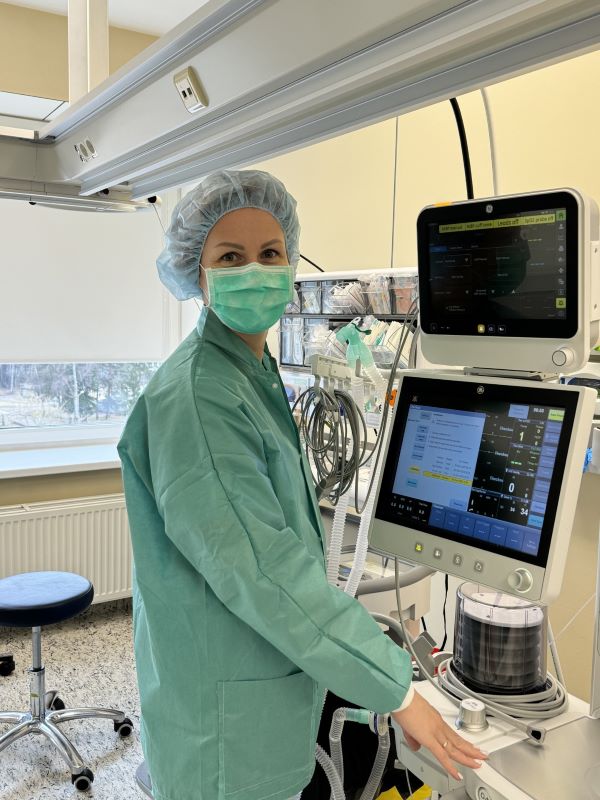
She opens up about both the smooth and the rough sides of nursing, the differences between the duties of an anaesthetic nurse and a palliative care nurse, her nursing studies, where simulation-based learning felt like a journey into the future — and the positive shift in public attitudes towards nurses.
Maira began her nursing studies at the age of 37. Prior to that, she had dedicated herself to raising three children and worked various jobs, including a period as a manicure and pedicure technician. It was while providing foot care to a friend that the idea struck her: why couldn't she become a podiatrist? ‘During my podiatry placement at the State Burns Centre, something just clicked. While treating wounds, I realised that I loved this kind of work, and that podiatry might not quite be my true calling,’ Maira reveals.
As a result, shortly after obtaining her podiatry diploma, she enrolled in a nursing programme in 2019. At that time, this entailed three years at the Red Cross Medical College, followed by a final year in the RSU Nursing bachelor’s programme. She then continued her studies at master’s level.
From palliative care to anaesthetic nursing
You are currently working as an anaesthetic nurse. Many people’s perception of an operating theatre comes from films, where flashing red lights signal an emergency and everyone rushes to save the patient. If such a situation occurs, what does the anaesthetic nurse do?
When the ‘red warning light comes on’, the doctor instructs the assisting nurse on what action to take, for instance, lowering the operating table, or preparing medications to stabilise the patient’s condition or for resuscitation. The more professionals respond in that exact moment, the better the outcome.
So, a nurse’s actions must be swift and precise…
Absolutely! One of the greatest risks associated with nurse burnout, overwork, and patient safety is medication mix-ups. Many medicines come in very similar packaging. For example, atropine and adrenaline ampoules are almost identical, differing only in colour and labelling.
Even in stressful situations, you must check three times what you are holding, because a nurse’s primary responsibility is to administer the correct medication, in the correct dose, to the correct patient.
Yet, in reality, these major life-saving emergencies are surely the exception, and most things run smoothly and predictably, don't they?
In elective surgeries, such cases are indeed rare. In emergency surgery, they occur more frequently. That is why nurses rotate between emergency and elective procedures. At Vidzeme Hospital, we predominantly perform elective surgery, which means stress levels can be balanced very well. I also feel strongly supported by doctors and the rest of the team during challenging situations — we work as one team.
Of course, surgery always carries risks. These can range from difficulties in securing a patient’s airway to extremely serious complications, such as a sudden drop in blood pressure or even cardiac arrest. That is why the anaesthesia team must monitor the patient continuously. If spinal anaesthesia is used, the patient can communicate directly with the nurse about how they are feeling. Under general anaesthesia, we rely on anaesthetic equipment and monitoring devices, while also observing the patient visually. I never let my guard down for a single moment.
Vidzeme Hospital is a multidisciplinary hospital, and I participate in all types of surgical procedures.
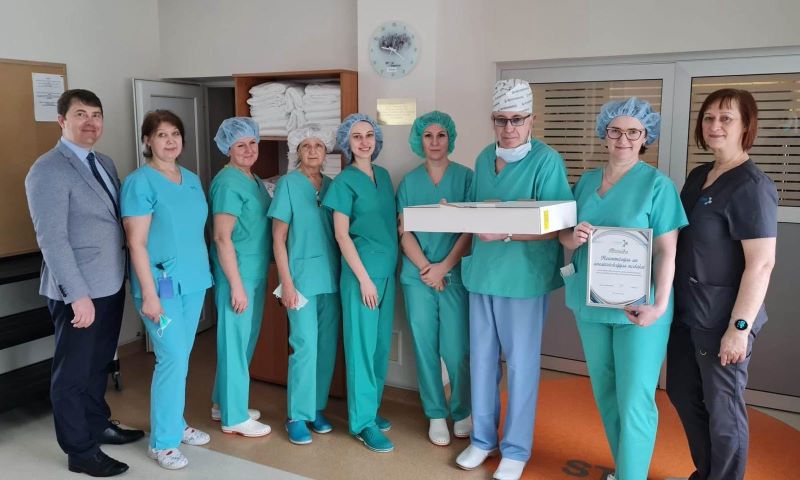
Upon entering the operating theatre, the nurse fits a pulse oximeter to measure blood oxygen levels, attaches electrodes to monitor cardiac activity, and sets up other necessary equipment.
After surgery, the anaesthetic nurse works alongside the doctor to wake the patient. Once the patient is fully awake, they are disconnected from the monitoring equipment and transferred back to the ward. Following spinal anaesthesia, this may happen within as little as 15 minutes. After general anaesthesia, however, the patient must first resume breathing independently. Only then can the breathing tube or laryngeal mask be removed. Before removal, the patient is gently awakened to ensure they can respond and breathe on their own.
I have noticed that if I explain beforehand that we will wake them after surgery and ask them to open their eyes when they hear their name, they truly do wake up when their name is called.
If you don't manage to discuss this beforehand, it sometimes feels like the patient doesn't wake up as promptly as we would like. During surgery, patients are generally anxious – both the young and the old. My task is to give everyone the feeling that people are beside them and that they are not alone on this journey.
We introduce ourselves, I explain where I will be during the procedure, and, if they remain conscious during the operation, I reassure them that they can call me by name and ask for help at any time – whether they are cold, uncomfortable, or simply uneasy about something.
So a significant part of a nurse’s work is providing emotional support?
Absolutely.
I have a photograph showing a patient’s hand resting on an arm support while I hold it. I held that hand throughout the entire operation.
The gentleman was nearly 90 years old, and it meant a great deal to him.
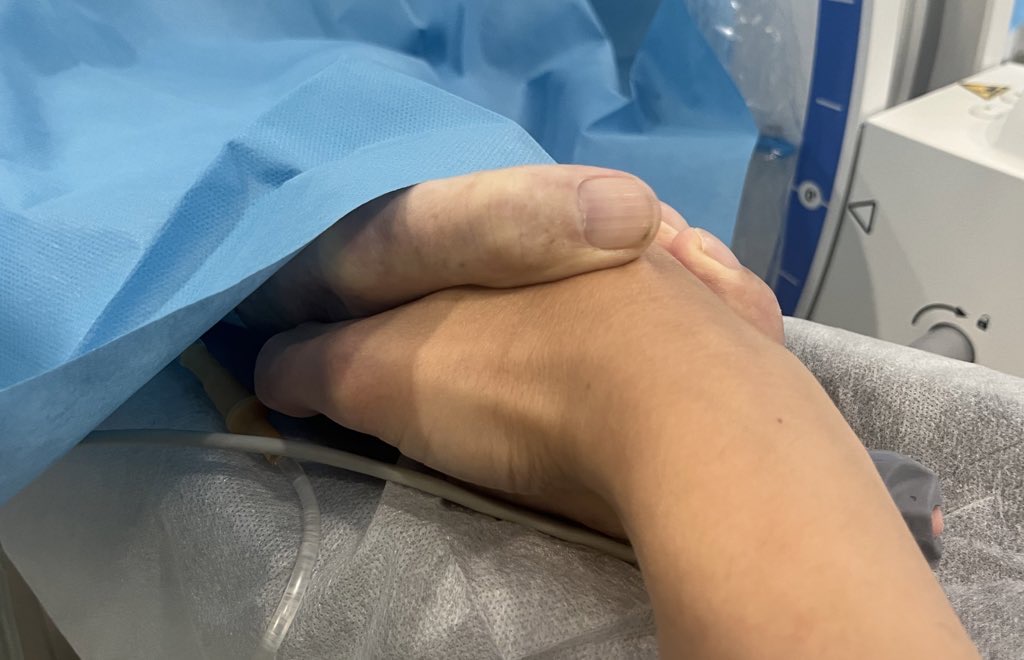
During surgery, patients are usually shielded from the sterile operating field. We sometimes joke – we will pitch a tent for you and you will have a picnic. We then spend our time together inside that ‘picnic tent section’.
Before joining the anaesthesia service, you worked in palliative care, where emotional support is of paramount importance.
Let me take a step back. During my placement at the Burns Centre, there was an anaesthetic nurse named Ņina. She said some words to me in Russian that stuck firmly in my mind: ‘We all live under the protection of the same God’. Any day, I could be the one in that patient’s bed. I carry these words with me as a guiding principle whenever I approach any patient. What every patient needs from me is support, understanding and respect. This is especially true in palliative and chronic care. Nurses are usually the first to notice changes in a patient’s behaviour or condition, such as the onset of pain.
My job is to communicate the patient’s concerns to the doctor, which makes the patient feel truly heard.
In palliative care, there comes a point when a patient is no longer conscious. Yet the dying process is often much slower than people imagine. When you are present throughout it, you witness every change. A skilled doctor and nurse can guide a patient through the process as comfortably as possible.
In palliative care, death often comes as a relief to the patient — the end of suffering. Family members naturally experience it differently. In intensive care, however, death is rarely the outcome we hope for. There, we strive to see improvement and recovery.
Studies at RSU
What did you find most interesting during your studies at RSU?
The RSU Medical Education Technology Centre — the simulation centre. It felt like a wonderland. We even saw simulated operating theatres. It was like watching a film about the future.
It is a massive advantage at RSU – to learn in a simulated environment, covering everything from emergency care to surgical procedures and much more.
The rewards of being a nurse
- Patients' gratitude
‘I do not mean flowers but a simple thank you. If you approach a patient with love, you will receive nothing but love in return. I receive a great deal of it (with very few exceptions). When they take my hands and say ‘Thank you, I felt safe!’, I need nothing more.’
- Technology provides significant support
‘Hospitals today are exceptionally well-equipped with advanced technologies, high-quality needles and other resources. Patient safety is a priority, and working conditions are good. At our hospital, swift technical assistance is always available if a machine malfunctions.’
- A highly respected profession
‘The days when people would say, ‘Oh, you’re just a nurse,’ are long gone. I recently met a few former classmates, and when they learned that I am a nurse, their reaction was: ‘Wow!’ Here in the region, I feel that the nursing profession is genuinely valued.’
- Employee benefits
‘At Vidzeme Hospital, staff members receive employer-funded physical exercise sessions led by a physiotherapist, a solid health insurance policy that covers dental care and other services, along with various other perks. Through these measures, the hospital management demonstrates that employees are highly valued.’
- Nurses will always be needed
‘The Nursing programme is unique because it allows you not only to earn a living but also to experience the emotional fulfilment that comes from helping people and being an essential member of society. After all, healthcare simply cannot function without nurses.’