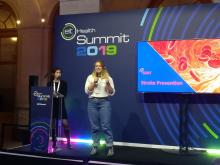
Placing a smart device in a blood vessel to act as a filter that would warn of the risk of stroke is the healthtech idea devised by the Smart Umbrella team formed by students from Rīga Stradiņš University (RSU). In December 2019 Smart Umbrella was chosen as one of three winners at a prestigious competition organised as part of Innovation Days in Paris. Ideas pitched by 33 teams, including such leading European science and study centres as the Karolinska Institute, Oxford University and Sorbonne University, were among Smart Umbrella’s competitors.

An echinococcus infection is caused by an approximately 5mm long parasite which can be caught by consuming parasite eggs found on berries and fruit from orchards or the forest, or by stroking dogs and cats, for example. Echinococcosis is a serious and usually incurable disease, where patients often have to take medication for the rest of their lives.

Professor Andrejs Millers, Head of the Department of Neurology and Neurosurgery of Rīga Stradiņš University (RSU) and Head of Neurology Clinic at Pauls Stradiņš Clinical University Hospital (PSCUH), in a conversation on receiving the Order of Three Stars, his life in medicine, lecturers, students, orienteering, conquering icy mountain ranges and the future.
How to choose a good journal wisely?
The purpose of this tailor-made training is to familiarize researchers, librarians and information specialists with the principles of a smart journal choice, which will allow good recognition and visibility of the published work, while avoiding dubious periodicals. The content, as well as with the available bibliometric parameters within Scopus will be presented and discussed.
A Doctoral School seminar on qualitative research methods in social sciences titled Ethnographic method and theory generation will be held on 16 December.
A Doctoral School seminar on qualitative research methods in social sciences titled Research design, epistemology, ethics, choosing methods will be held on 9 December.